

Sponsored by 3137 Capital
Good morning. Happy first day of September! Already a month into Margin Call on Pay Me In Plane Tickets and it’s truly such a joy to deliver and hear the responses. Enjoying our growing community. Remember its PMIPT not PIMP — we’ll leave that for 50.

Be First —
Just last week on Margin Call, we discussed Google buying Spirit’s bankrupt data for a mere $10M.
Now, Google would like you to believe it has spent the past year quietly building the connective tissue between search and shopping, and this week it switched a rather important light on: you can now book a hotel room, in dollars, without leaving the AI chat window. This is either the natural endpoint of “search” — a page that finds things — evolving into “commerce” — a page that sells things — or it is Google finally admitting what search always secretly was. The company has signed up the usual suspects. Marriott, Expedia, Booking.com, Hilton, IHG. And insists, hand on heart, that the results you see are ranked the same way organic search always has been, no ads, no thumb on the scale. I believe this the way I believe any tech company telling me its ad-free era will last: sincerely, and with a raised eyebrow, because nobody builds a distribution funnel this valuable and leaves it un-monetized for long. That would be a first, if ever. The tell is that Google itself won’t rule out ads later — which in corporate dialect means the meter is already running, it’s just not itemized on your receipt yet.
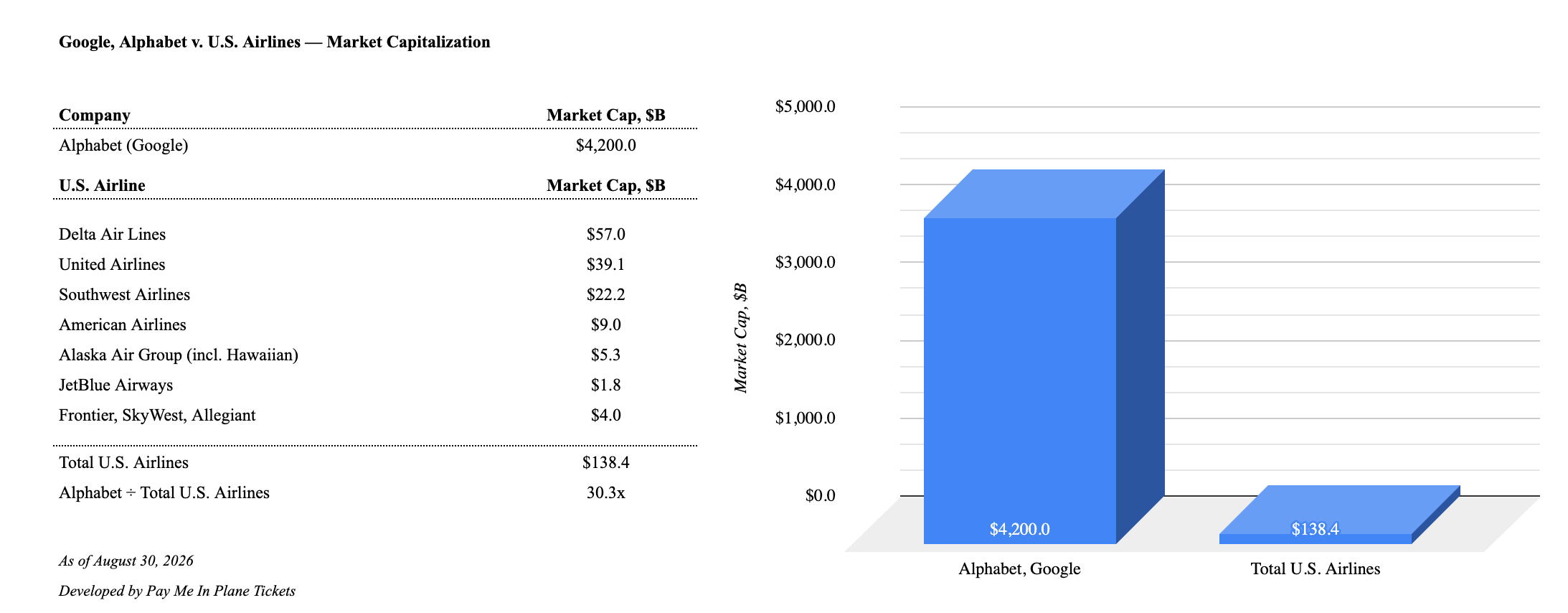
Flights are the more interesting story precisely because nothing happened. You can track prices, you can burn miles, you can build an itinerary — and then Google politely walks you off its own platform to actually pay for the thing, the one part of the transaction that would have made this launch genuinely disruptive to the Expedias and the airlines of the world. That restraint is either commendable caution about a much messier market. Think dynamic pricing, fare rules, a dozen legacy reservation systems held together with duct tape or possibly, evidence that Google hasn’t yet worked out how to take a cut without picking a fight with the airlines it needs as partners. And I say fight, loosely. Because even with the combined might of all US airlines if ever tied together - Alphabet could buy all US airlines, take all of their hubs and turn them into ping pong rooms. As I mentioned earlier, layer onto that the small, unrelated, entirely coincidental fact that Google recently bought a trove of data from the corpse of Spirit Airlines, and you have a company assembling a very large machine one gear at a time, while insisting each gear was purchased for reasons that have nothing to do with the others.
Be Smarter —
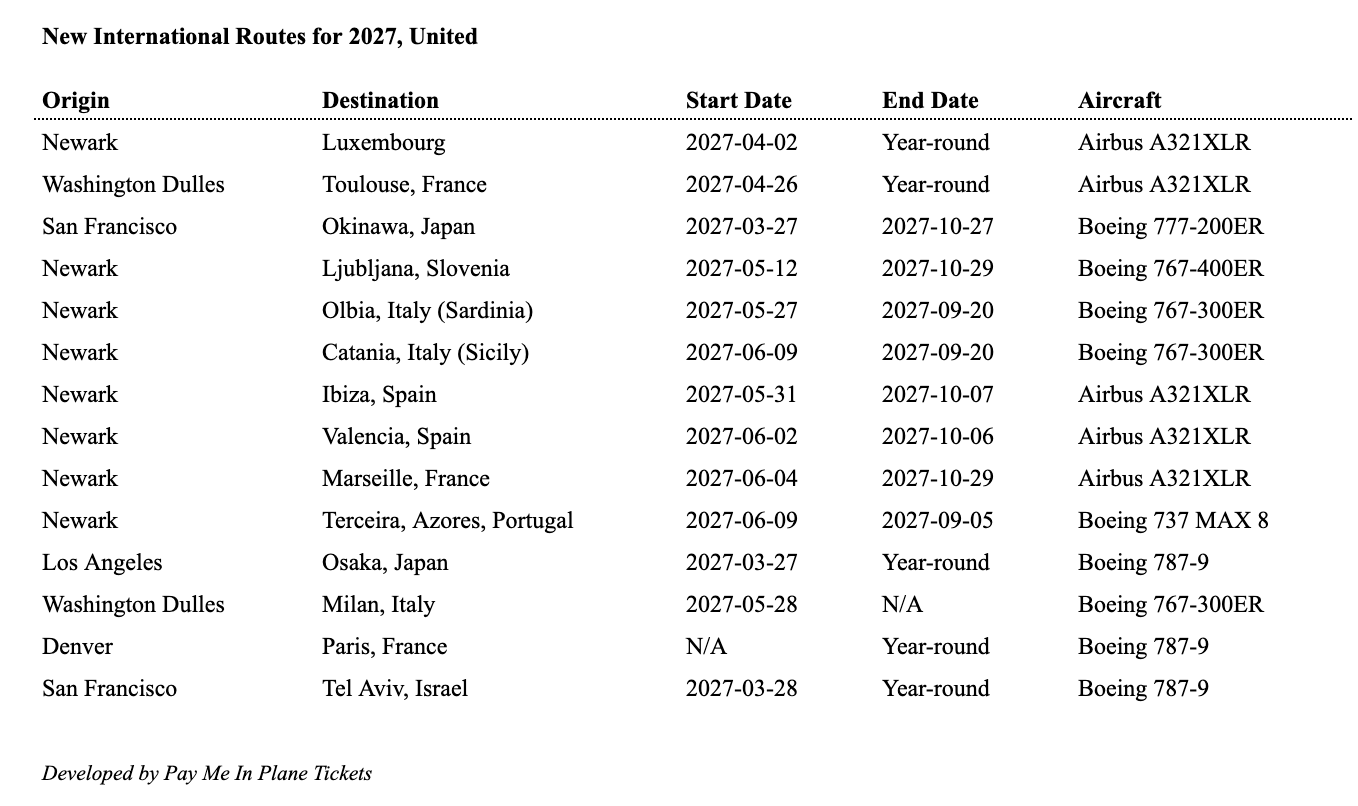
United added ten new international cities for summer 2027, and the mix says more about strategy than the press release does. Most are classic leisure routes — Ljubljana, Ibiza, Catania, Valencia, the Azores — the kind that fill an A321XLR's economy cabin with sun-seekers chasing cheap fares. But two additions stand apart: daily Newark–Luxembourg, aimed at the banking corridor linking Wall Street to the Grand Duchy, and Washington Dulles–Toulouse, which conveniently connects Airbus's American and European operations. That's the smart part — United is using low-risk, high-volume leisure growth to soak up its expanding long-haul fleet while quietly building higher-yield corporate routes that are stickier than a sunseeker's summer plans, since business travelers don't rebook over a nine-dollar fare difference. It's effectively a portfolio approach to network planning: breadth for the loyalty program, depth for the corporate accounts, without betting the expansion entirely on either.
Or Cheat —
Uber has spent the past several years insisting that its fares are simply the honest arithmetic of inflation and driver pay, a claim that has always required the listener to not ask too many follow-up questions. A good friend of mine forwarded to me this new and intriguing investigation from More Perfect Union. The outlet found that the “insurance fee” tacked onto rides — which Uber says reflects real risk — instead moves in near lockstep with the price of the ride itself: one driver, running the identical route with the identical rider, watched the charge swing from $13.75 to $50. That is not underwriting. That is a second fare, wearing a lab coat or a widely complicated yet clever cheat.
The more interesting detail, and the one that should worry regulators more than riders, is who is actually collecting this money. The insurance flows to Aleka, a Hawaii-domiciled captive insurer owned outright by Uber and staffed by its own former executives, which by the investigation’s accounting retains 95 cents of every insurance dollar inside the parent company.
Equivalent of paying your own bar tab and calling it a business expense — technically a transaction, substantively a shuffle. And because Aleka’s sole customer is Uber, it owes no one a public accounting of its books. Uber’s on-the-record defense is that the fee tracks distance, duration, time of day and weather, not price — a claim the company is, conveniently, the only party able to verify.
Enjoy the first day of September my fellow readers. Margin Call is on a break, returning September 14th. ✊🏾 Margin Call is issued weekly on Tuesdays, found only on Pay Me in Plane Tickets!
The question for independent hotels isn't only whether AI makes booking easier. It's who owns the guest relationship when discovery and transaction collapse into the same interface. The brands and OTAs already have the data, inventory and technical connections to show up first. Independents will need a much clearer distribution strategy, and a reason for the guest to come back direct after that first AI-assisted booking.