


As the American government grinds through a funding impasse—now the longest shutdown in U.S. history—the normally seamless operations of the nation’s air traffic control system are beginning to fray, exposing a perilous fragility beneath the veneer of daily commerce.1 On Wednesday, November 7 2025, the Federal Aviation Administration (FAA) announced an unprecedented measure: a mandated 10 percent reduction in air traffic capacity across 40 of the country’s busiest markets, effective Friday. The move is a desperate, preemptive strike against what Transportation Secretary Sean Duffy called the “chaos in the skies” threatened by a mounting crisis of staffing and fatigue.2
The Unpaid Sentinels of the Airspace
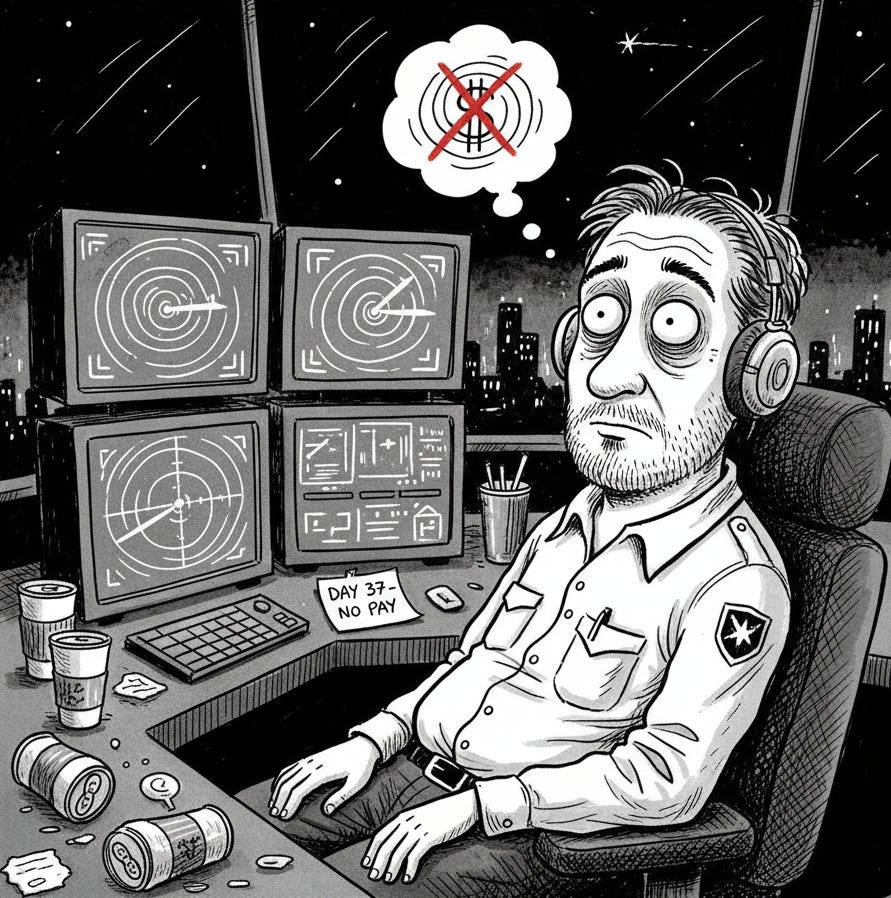
The core of this systemic strain rests squarely on the shoulders of the country’s roughly 13,000 air traffic control officers.3 Deemed essential personnel, these men and women have been reporting to their radar scopes and control towers for over a month, working demanding, high-stakes shifts without a paycheck. They are the unpaid sentinels of the airspace, working mandatory six-day weeks and overtime, even as the government that employs them refuses to release their wages.
The human toll is palpable. Reports from across the nation paint a picture of extraordinary duress: controllers taking second jobs, struggling to cover basic expenses like groceries or the fuel to get to work, and battling a profound, distracting anxiety. FAA Administrator Bryan Bedford was unambiguous about the agency’s motivation for the reduction, citing a surge in voluntary safety disclosure reports from pilots and a clear pattern of “fatigue building in the system.” The number of air traffic control facilities reporting potential staffing limits has quadrupled since the shutdown began, a stark metric of a system pushed to a tipping point.
This unprecedented working condition—a highly technical, high-stress job performed while under extreme financial duress—is one that no industry would tolerate, let alone one responsible for the safe transit of tens of thousands of lives daily. The decision to cut capacity, though disruptive, is an official acknowledgment that the cost of inaction—a catastrophic error resulting from an exhausted controller—is far too high. As Secretary Duffy put it, “We are not going to wait for a safety problem to truly manifest itself.”
The 10% reduction—expected to ground an estimated 3,500 to 4,000 flights per day—is an attempt to create a necessary margin of safety, a buffer in a system where time and cognitive acuity are the most precious commodities.4 While the official list is forthcoming, proposed targets include major hubs such as Hartsfield-Jackson Atlanta International (ATL), Dallas/Fort Worth International (DFW), Chicago O’Hare International (ORD), and Los Angeles International (LAX).5
The Domino Effect on the Commercial Carriers
The FAA’s mandate—which could mean the elimination of up to 4,000 flights daily—immediately sent shockwaves through the commercial aviation sector. Major carriers like United, American, and Southwest are now hastily rejiggering their flight matrices. United Airlines CEO Scott Kirby indicated the carrier would prioritize preserving international and hub-to-hub routes, focusing cuts on regional and domestic mainline services to maintain network integrity.
While the airlines are working to “mitigate impacts” for passengers, the ripple effect on the finely-tuned, just-in-time logistics of the industry is inevitable.
Financial Impact: The immediate financial hit from canceling thousands of flights—estimated by some analysts to remove nearly 268,000 passenger seats from the market—will be a material cost.6 However, the industry’s historical resilience suggests that a short-term reduction, while painful, may not entirely derail their profit outlook, provided the shutdown ends soon. During the 2018-2019 shutdown, airline stocks, perhaps counterintuitively, often rose, a reflection of investor belief in the enduring demand for air travel. Carriers are better positioned today with stronger balance sheets and more profitable loyalty programs. However, a prolonged reduction, especially if it extends through the critical holiday travel season (near - end of November through December), would almost certainly translate into significant, unrecoverable revenue loss and damage to consumer confidence.
Operational Strain: Beyond the cancellations, the cuts introduce new layers of complexity. Shorter schedules mean fewer options for passengers on delayed flights, increasing the likelihood of long airport strandings and cascading delays across the entire network. For an industry that measures efficiency in minutes, a 10 percent systemic slowdown is a bureaucratic and logistical headwind of historic proportions.
The Political Brinksmanship and a Record of Dysfunction
The backdrop to this operational breakdown is the grinding political stalemate that has rendered the U.S. government—and its most critical functions—a casualty of political brinksmanship. Day 36 of this funding lapse set a new, unenviable record, eclipsing the 35-day shutdown of 2018-2019.
The fight is over a fundamental disagreement on funding—one side insisting on a clean bill, the other demanding an extension of key healthcare subsidies—yet the consequence has been a national system of transportation brought to the edge of crisis. As the shutdown endures, the economic costs, now estimated to run into the billions weekly, will continue to mount, yet it is the image of the uncompensated, fatigued air traffic controller—the very person safeguarding the airspace—that remains the most searing indictment of this political dysfunction.
The FAA’s mandate is not merely a scheduling adjustment; it is a profound signal that the government’s ability to maintain a foundational pillar of its infrastructure has been compromised. The flying public, and the airlines that serve them, are now left hoping that the fear of a severely constrained, and potentially less safe, air travel system will be the necessary catalyst to end the longest government closure the nation has ever endured.