


There is a particular kind of American obsession that announces itself quietly, almost reasonably, before consuming everything in its path. It begins with a question that seems like it ought to have an answer — a clean, empirical, archivable answer — and then proceeds to swallow careers, marriages, fortunes, and decades. Rachel Hartigan, a former editor and reporter for National Geographic, recognized this pattern when she set out to write about Amelia Earhart’s disappearance in 1937. What she may not have anticipated was how fully she would become a character in the story herself.
Listen to Rachel Hartigan on Pay Me In Plane Tickets Radio
Her new book, Lost: Amelia Earhart’s Three Mysterious Deaths and One Extraordinary Life, published this spring, is a dual-threaded narrative: one strand follows Earhart’s life from her itinerant, unsettled childhood in Atchison, Kansas, through her ascent as the most famous aviator in the world; the other pulls the reader into the present-day vortex of investigators, obsessives, and forensic scientists attempting to determine where Earhart and her navigator, Fred Noonan, ended up when their Lockheed Electra vanished over the central Pacific on July 2, 1937. The result is something richer and stranger than a biography or a mystery: it is an inquiry into the nature of myth itself, into what happens when a real woman is conscripted into the service of a nation’s self-image, and into what it costs — in time, in money, in sanity — to try to pull her back out.
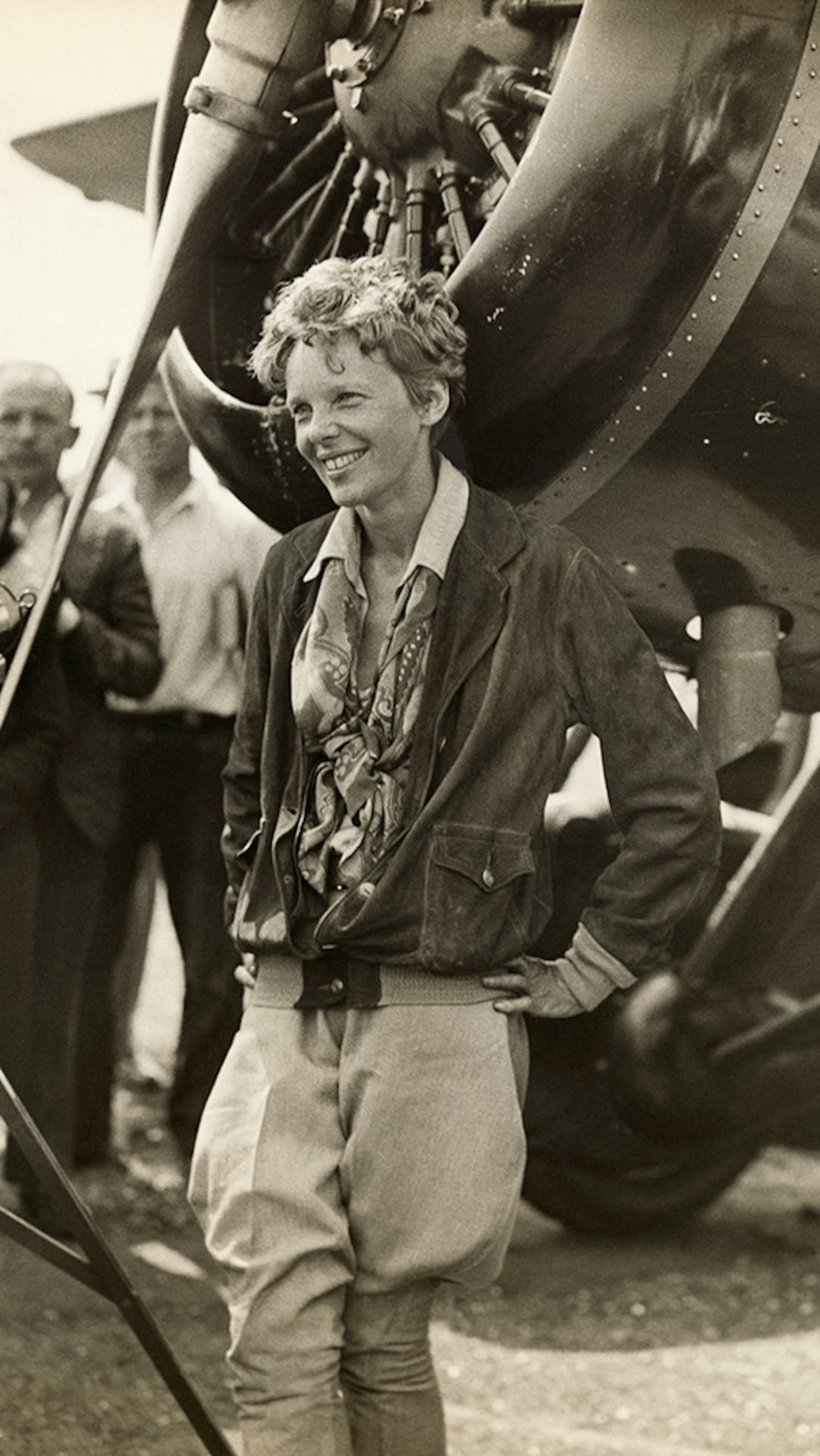
The three theories Hartigan examines have each attracted their own faithful. The first holds that Earhart and Noonan crash-landed near the Marshall Islands, were captured by Japanese forces who suspected the aviatrix of being an American spy, and died in captivity. The second, championed by a group called TIGHAR, maintains that the plane made an emergency landing on the remote atoll of Nikumaroro, in what is now Kiribati, and that the pair died there of thirst, starvation, or injury before anyone came looking. The third is the one most aviation experts consider most probable: the fuel simply ran out, the plane went into the ocean, and Earhart and Noonan died quickly and without drama, their wreckage settling to a sea too deep and vast to be meaningfully searched. This is the death with no story to tell, which is perhaps why it has attracted the fewest devoted adherents.
Hartigan is at her best when describing the world of the searchers — a world that exists somewhere between rigorous scientific inquiry and something resembling a calling. She joins an expedition to Nikumaroro, where forensic dogs are deployed to search for biological traces that might, if the stars align and the science cooperates, yield a sample of Earhart’s DNA. The image of cadaver dogs nosing through Pacific undergrowth in search of an eighty-nine-year-old scent is one of the book’s most indelible. What she finds is tantalizing but inconclusive — bone fragments that may or may not be human, artifacts that could support the castaway hypothesis or could mean almost anything else. This is the epistemological trap the Earhart mystery sets for anyone who approaches it in good faith: the absence of conclusive evidence is not the same as evidence of absence, and those devoted to the search have learned to live very comfortably in that gap.

The life threaded through all of this searching is extraordinary enough to justify a book without any mystery attached. Earhart was born in 1897 to a family undone by her father’s alcoholism, her childhood marked by instability and the humiliation of genteel poverty. She discovered aviation almost accidentally at a county fair in 1920, and the experience was transformative: she knew, looking down from an open-cockpit biplane, that she would spend her life in the air. What Hartigan excavates with particular care is the role played by George Putnam — the publisher who became her husband in 1931 — in constructing the Earhart the world came to know. Putnam understood that her value was not merely aeronautical but symbolic, and he was skilled at knowing which elements of her story to amplify and which to quietly set aside. The result was a figure both more and less than the real woman: more heroic, more serene; less complicated, less frightened, less aware of the gap between what she projected and what she felt.
The world flight attempt that ended in the Pacific in July of 1937 was Earhart’s second try at an equatorial circumnavigation. The last confirmed radio contact placed the plane somewhere over the central Pacific, running low on fuel, unable to locate the tiny island of Howland where a Coast Guard cutter was waiting. The transmissions grew more anxious, then stopped. The search that followed was the largest in United States naval history at that point, and it found nothing. Hartigan does not pretend to know what happened in those final hours — what she does instead is map the topology of not-knowing, the strange geography that opens up when a question refuses to close, and ask what it tells us about America’s need for its heroines to be simultaneously triumphant and unfinished.
The book has been praised by writers whose enthusiasm tends to be reliable — Susan Orlean called it “beautifully reported and gracefully written,” and Hampton Sides described it as revealing Earhart as a powerful figure of fable and myth who still ignites a sense of wonder. Hartigan writes with clarity and control, and she has done the kind of reporting — traveling to remote islands, sitting with obsessives, reading correspondence and flight logs and forensic reports — that makes the book feel genuinely earned. If there is a reservation, it is that the alternating structure can occasionally feel like two excellent magazine articles stapled together in a binding slightly too small for both. But Lost takes a subject that has been done many times and finds in it something genuinely new to say.
Amelia Earhart disappeared at forty years old, in the middle of an adventure she had chosen freely. The tragedy, Hartigan suggests, is partly retrospective — something we project onto her story from the other side of the silence. We need her to have suffered, to have been wronged, to have been on the verge of something cruelly taken from her, because that is the story shape that makes the loss feel meaningful rather than arbitrary. The searchers on Nikumaroro, with their forensic dogs and carefully mapped grids, are doing something that looks like science but is also, underneath, something older: they are trying to recover a body so that it can be properly mourned. Rachel Hartigan knows this, and she has written a book that is honest about it. In the end, Lost is less about what happened to Amelia Earhart than about what it means to care, this deeply and this persistently, about a woman who vanished into the Pacific almost ninety years ago. That is, it turns out, quite a lot to care about.

Lost: Amelia Earhart’s Three Mysterious Deaths and One Extraordinary Life