



There is a particular kind of fury that builds slowly, over years of small reimbursement checks, and then detonates all at once when somebody finally shows you the math. That is roughly what happened to dozens of Marriott International’s largest hotel owners this spring, when the company let slip, almost in passing, on a February earnings call, that revenue from its co-branded credit cards was on pace to climb about 35 percent this year, pushing toward $1 billion. For a long time, owners had been told that the Bonvoy loyalty program, the 30-brand-wide universe of points, status tiers, and free-night redemptions that Marriott has spent a decade building into the connective tissue of its business, more or less broke even. It was a cost center dressed up as a courtesy: a thing hotels paid into because it kept guests coming back, not because anyone made money from it. Then the owners did the arithmetic themselves, and the number didn’t look like a wash. It looked like a windfall, and not theirs.

In March, fifty-one ownership groups, representing nearly a thousand Marriott-branded hotels across the country, sent a letter to Chief Executive Anthony Capuano and Chairman David Marriott. The language was civil, in the way that letters from lawyers tend to be civil, but the complaint underneath it was not subtle. Hotel owners are absorbing an increasing share of the program’s costs while Marriott captures an increasing share of its revenue, the group wrote. Translated out of letterhead diplomacy: we own the buildings, we clean the rooms, we eat the cost every time a guest redeems points for a free night, and you, the corporation that owns none of that real estate, keep the fee.
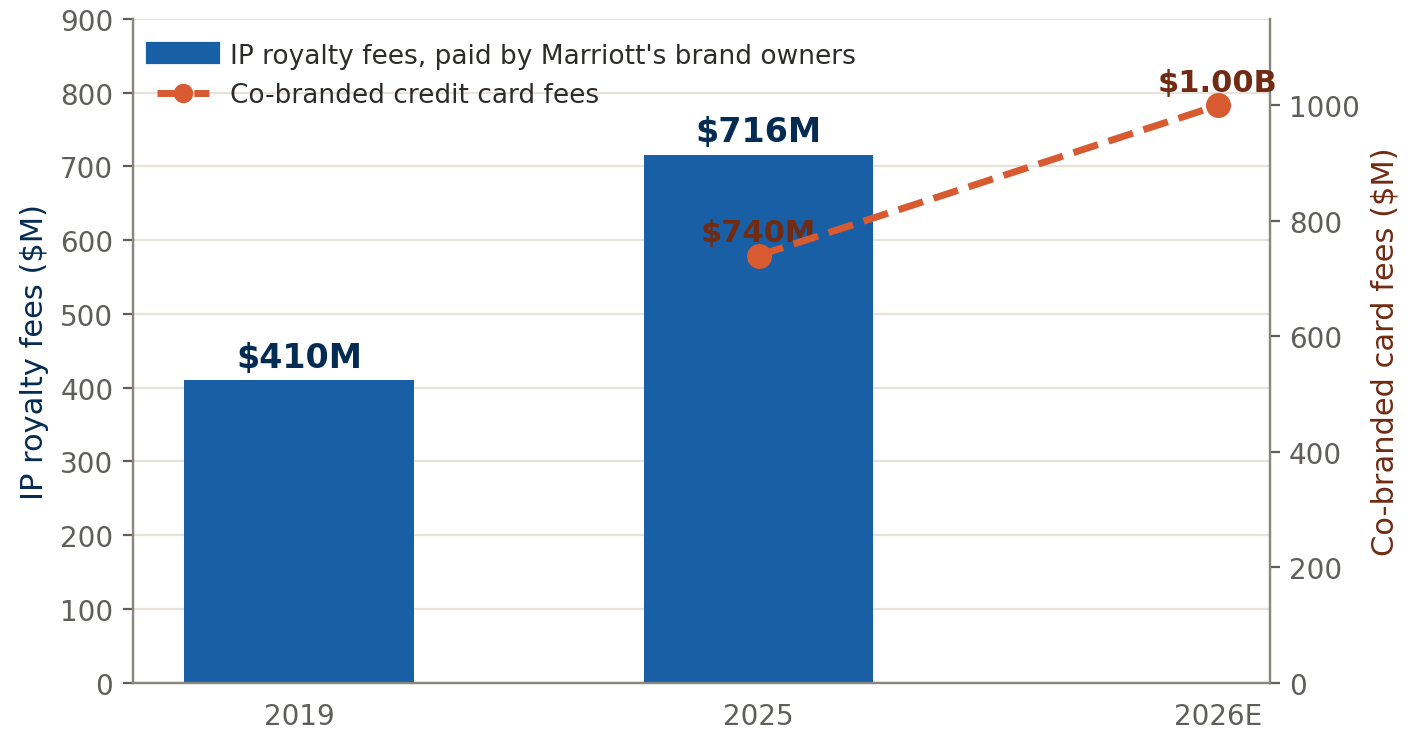
It helps to understand what Bonvoy actually is, because it is easy to mistake it for a perk and miss that it is, functionally, a distribution and financial-services machine. Marriott itself owns and operates almost none of the roughly 9,400 hotels that carry its flags; the company’s whole modern identity is “asset-light,” meaning it collects franchise royalties and management fees while owners shoulder the capital risk of the real estate. Bonvoy sits on top of that arrangement as the loyalty layer, and increasingly, as the place where the real money lives. Marriott’s IP royalty fees hit $716 million in 2025, up from $410 million in 2019 — a jump of nearly 75 percent in six years, in a business where the marginal cost of issuing another point is close to zero. Card fees are guided to roughly 16 percent of the company’s gross fees this year, up from about 13 percent in 2025, which is the sort of trajectory that gets a stock re-rated on Wall Street as a fee-collecting platform rather than a property company — and Marriott’s shares, trading recently around $400, have largely behaved that way.
The mechanism owners object to is almost elegant in its asymmetry. The card fee is a royalty that Chase and American Express pay Marriott directly — asset-light revenue that costs the brand almost nothing to collect. The expense, meanwhile, lives entirely on the other side of the ledger: every time a member books a free night on points, the owner of that hotel absorbs the room. One program, as a recent industry analysis put it bluntly, but two ledgers — the upside accruing to the flag in Bethesda, the cost sitting with the operator who actually changes the sheets. Owners had quietly tolerated this lopsidedness for years, on the theory that loyalty drove repeat bookings and new customers worth more than the discount. They paid into a fund managed by Marriott that compensated them, at below-market rates, when guests redeemed points for rooms — and one hotelier, writing on the travel forum One Mile at a Time, noted that the base reimbursement at his property runs less than $40 a night, regardless of room type, for a redemption that might otherwise have rented for ten times that on the open market.

What they are asking for now is specific, and notably modest given the size of the number that triggered it. At minimum, owners want compensation for loyalty-program stays to match what they already receive from third-party booking sites such as Expedia — a standard that, if you sit with it, is itself a quietly damning request: hotel owners are asking to be paid by their own franchisor at the same rate an outside online travel agency pays them for occupying the identical room. Beyond that, they want fuller financial disclosure on how the Bonvoy fund actually works, and a piece of the credit-card economics rather than just better terms on the redemption side.
The timing is not incidental. Marriott is renegotiating its credit-card agreements right now, which means the contracts that will lock in this revenue split for years are open at precisely the moment owners chose to apply pressure — a fact unlikely to have escaped either side. Marriott, for its part, has not dismissed the complaint outright. The company says it takes the concerns seriously and has already made gestures toward conciliation: it has cut loyalty charge-out rates in places and raised reimbursements for award stays on high-demand nights, and shared some Bonvoy financial detail with owners for the first time. Whether that amounts to a real concession or a pressure valve depends on what survives the credit-card renegotiation, and that won’t be visible from the outside for some time.

What makes the dispute worth watching is less the dollar figure, real as it is, than what it exposes about the architecture of the modern hotel business. Marriott does not primarily sell rooms anymore; it sells access to nearly 283 million Bonvoy members, a database that banks, airlines, and retailers all want a piece of, and it has built a royalty stream on top of that access that grows almost independent of how many rooms actually get filled. The owners, who still bear all the old risks of hospitality — labor costs, capital expenditure, a leaky roof in Tulsa — are discovering that the part of the business getting richest is the part with no rooms in it at all. The letter from fifty-one owners is, in that sense, less a labor dispute than a referendum on who actually owns the value in a brand once the brand becomes a platform. Marriott built the loyalty program to keep guests faithful to its hotels. It may not have anticipated that the hotels would eventually want to know exactly how faithful the program had become to its parent company instead.