


There is a particular paralysis that overtakes a person who types “things to do in Lisbon” into a search bar on a gray Tuesday in February. The machine returns, in seconds, a ranked and algorithmically confident list: the Alfâma quarter at dawn, a pastry at Pasteis de Belém, a ride on Tram 28. The specificity is dazzling and strangely deadening at once, as though the city has already been pre-visited on your behalf. What you experience, in the end, may be less a discovery than a confirmation.
This is the promise and the predicament of artificial intelligence in travel planning: a competence so thorough it risks replacing the fumbling, serendipitous process by which we have always discovered somewhere new. The adoption curve has been steep and startling.
According to Global Rescue’s 2025 Traveler Safety and Sentiment Survey, traveler use of AI for trip planning more than doubled between October 2024 and July 2025 — from eleven percent to twenty-four percent.
Among those under thirty-five, the figure climbs to forty percent. A parallel Statista study placed global adoption even higher: roughly forty percent of consumers worldwide reported using an AI-based tool for travel planning as of late 2024, with millennials leading at fifty-seven percent. In the United States, a third of travelers now use generative AI in their travel process, well ahead of the U.K.’s twenty-two percent and Germany’s fifteen. Generating trip itineraries, according to a 2025 global study, ranks as the single most common use of AI-powered features among travelers — ahead of price comparison, review analysis, and language assistance.
And yet there are interesting fissures in the data. A YouGov survey conducted in the summer of 2025 found that comfort with AI in travel planning had actually declined among younger Americans — the demographic presumed to be its most enthusiastic adopters. Among eighteen-to-twenty-four-year-olds, comfort levels dropped from forty-seven percent in 2024 to thirty-four percent a year later: a thirteen-point retreat that surprised researchers. The generation that grew up swiping and streaming appears to be developing a reflexive skepticism about ceding yet another life experience to an algorithm. Meanwhile, the thirty-five-to-forty-four cohort quietly became the most AI-positive demographic in the United States — adults old enough to remember planning before the internet, and young enough to embrace its successor.
The model produces the consensus trip — the distilled essence of what millions of prior visitors found notable. What it cannot generate is genuine novelty.
The philosophical objection to AI trip planning is not, at its heart, about accuracy or efficiency. It is about something more intimate: the productive anxiety of not knowing what you will find. The wrong turn into an unnamed trattoria. The unexpected festival encountered while trying to navigate out of a village. The bookstore discovered it because you got off one stop too early on the Metro. These are not bugs in the travel experience; for many people, they are precisely the point. When a language model generates an itinerary, it draws on the aggregated experience of everyone who has already been somewhere and written about it — producing the consensus trip, the distilled essence of what millions of prior visitors found notable. What it cannot generate is genuine novelty. It can recommend the neighborhood that travel writers began rhapsodizing about eighteen months ago; it cannot recommend the block that no one has noticed yet. The horizon it offers is real, but it is always, in some sense, behind you.
Overtourism
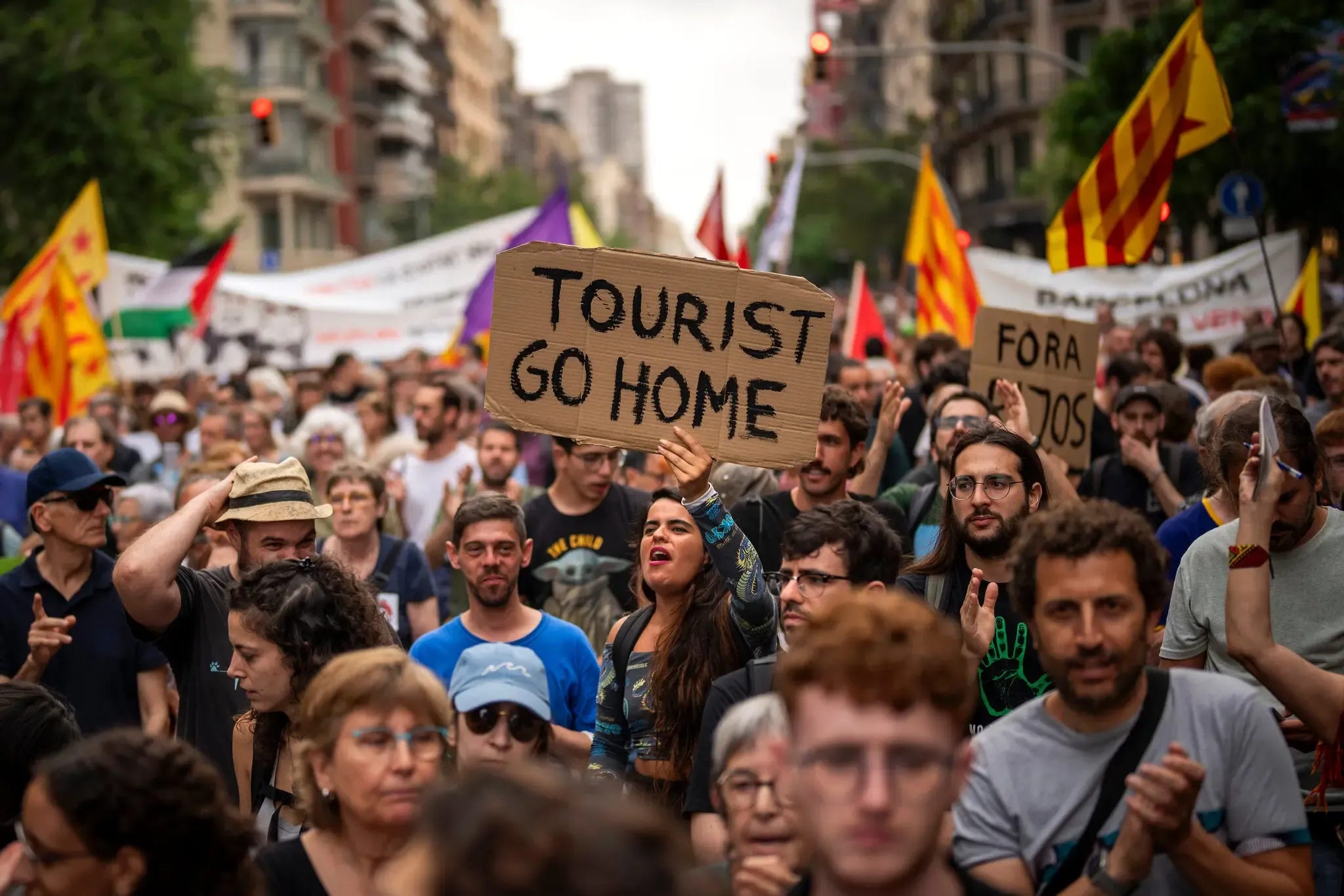
There is also the question of what happens to a place when it is consistently surfaced by the same algorithmic recommendations to millions of users simultaneously. The overtourism crisis that has beset Venice, Barcelona, and Dubrovnik long predates generative AI, but the logic of AI optimization — find the best, surface the best, route everyone toward the best — seems engineered to accelerate it. When every traveler consults the same model for a hidden gem, the gem ceases to be hidden within weeks. The machine, in its eagerness to please, may be quietly cannibalizing the very experiences it promises to deliver.
Travel Advisors

The moat around the travel advisor is not knowledge. It is judgment, relationship, and the willingness to answer the phone.
No professional cohort is watching these developments more carefully than the travel advisor industry — a sector that survived the online booking revolution of the early 2000s by retreating upmarket, and now finds itself contemplating a second such upheaval. A 2025 TravelAge West survey found that forty-five percent of travel advisors believe AI-powered tools could eventually threaten their role, up from thirty-eight percent two years prior. A global RateHawk study put the concern at forty-four percent of agents worldwide. And yet advisors are not retreating; they are adapting. In 2023, sixteen percent used AI in their practice. By 2025, fifty-eight percent do. Seventy-three percent plan to increase that use over the next twelve months — a striking reversal from 2023, when more than half said they had no plans to use the technology at all.
What AI genuinely cannot replicate, advisors will tell you, is the architecture of accountability. A chatbot that hallucinates a nonexistent resort does not receive your panicked call from the airport. It does not have a relationship with the general manager who can find you a room when the booking system has failed. It does not know that your clients, despite requesting an “adventurous” itinerary, are actually the kind of people who will be miserable without reliable Wi-Fi and a Western-style shower. A 2024 Forbes Advisor survey found that seventy-one percent of travelers value human support specifically when things go wrong — which is to say, in the moments that matter most. The moat around the travel advisor, it turns out, is not knowledge. It is judgment, relationship, and the willingness to answer the phone.
The algorithm knows you’re going to Rome. It knows the best time to book, the quietest piazza at noon, the restaurant that opened six months ago and has not yet been overrun. What it cannot know is what you will make of all of it — what unplanned moment will become the one you talk about for years. Nearly half of AI users still verify the machine’s recommendations elsewhere; only twenty-two percent trust it with minimal review. The fastest-growing cohort of AI skeptics is also among the youngest, as though the generation most shaped by digital mediation is also the first to sense its costs. Perhaps what we are watching is not a straightforward takeover but a negotiation: between the human desire for efficiency and the equally human desire to be surprised, between the comfort of the known itinerary and the stubborn pull of the uncharted road. That remainder — whatever it amounts to — may be the last truly human part of travel. For now, it appears, we are still fighting to keep it.