


There is a passage of water, twenty-one miles wide at its narrowest point, between the Omani coast and the Iranian shore, through which, until recently, roughly one-fifth of the world’s oil quietly flowed each day. The Strait of Hormuz is not, as a piece of geography, especially dramatic. It is not the Grand Canyon. It does not inspire postcards. But when Iran effectively closed it earlier this year in response to U.S. and Israeli military action, it managed, in a matter of weeks, to accomplish something that no number of airline mergers, no fleet of consultants, no pandemic-era revenue-management algorithm had quite pulled off: it made the dream of affordable air travel feel, briefly, historical.

Jet fuel prices have risen more than eighty percent since the war on Iran began in late February, and the arithmetic from there is not especially forgiving. In the United States, jet fuel hit a record $4.62 a gallon — a number that would look modest on a Manhattan cocktail menu but is, for an industry that burns millions of gallons a day, the difference between a quarterly earnings call that goes smoothly and one that does not. Domestic airfare is up eighteen percent, according to Going.com, while international airfare has risen seven and a half percent — figures that, stated plainly, obscure the more vivid reality of the gate-agent encounter, the involuntary reroute, the itinerary that evaporates.
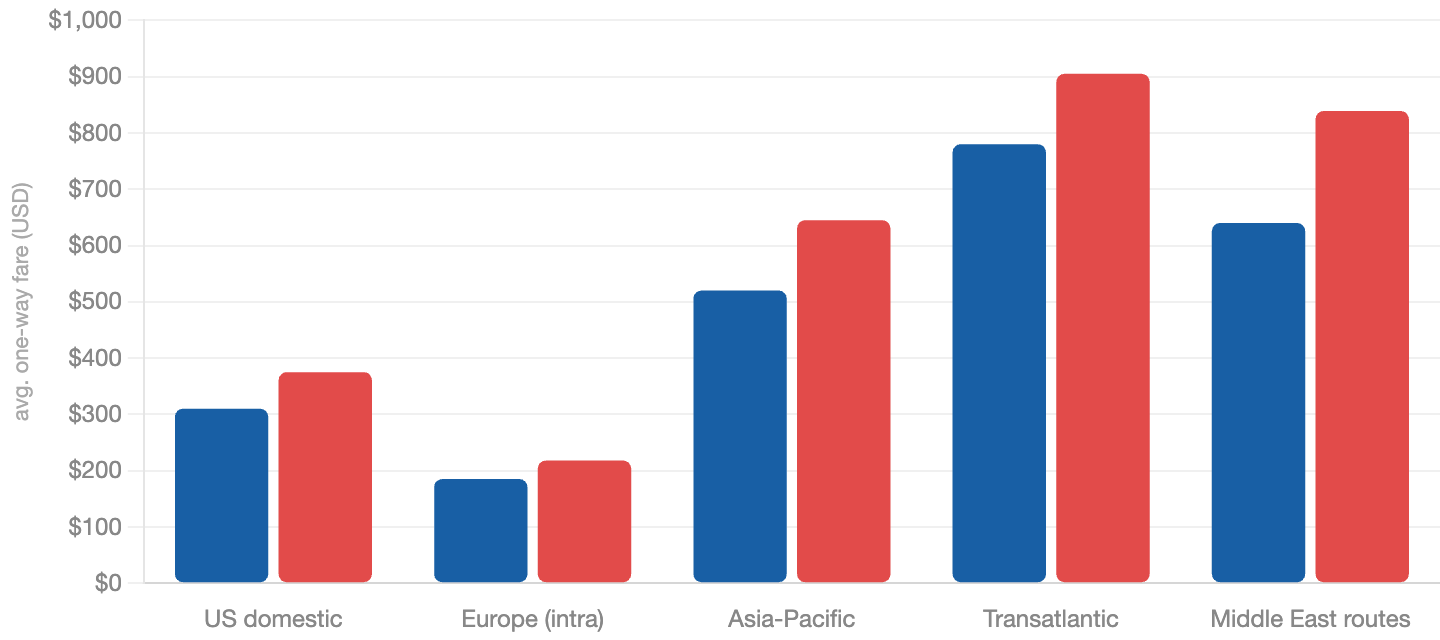
The effects have a certain grim democratizing quality. U.S. domestic flight prices were up twenty-one percent year-on-year in March, and AirAsia’s chief executive likened the fallout to the widespread shutdowns of the pandemic. Alaska Airlines, which runs a hub out of Seattle-Tacoma, said rising fuel prices were likely to add an extra $600 million in expenses between April and June, and responded by increasing ticket prices, raising checked-bag fees, and cutting routes. Spirit Airlines, the carrier that once seemed to exist specifically to remind passengers that air travel could always be made slightly less pleasant for slightly less money, announced it would permanently cease operations, a move widely attributed to soaring fuel costs.
The supply problem is not merely financial; it is, in places, physical. South Korea asked its government to help redirect fuel stocks bound for export back to local markets. The United Kingdom faced an acute shortage, with no Britain-bound cargoes visible on the water as transit through the Strait of Hormuz remained blocked. The disruption has already cut off nearly one-fifth of global seaborne jet fuel supply, sending shockwaves through airlines, airports, and tourism-dependent economies across Asia, Europe, and Africa.
Airlines, for their part, have responded with the full repertoire of cost-passing instruments available to a lightly regulated oligopoly under stress: fuel surcharges appended to tickets like footnotes no one reads, bag fees adjusted upward with the confident asymmetry of a ratchet, and route cuts administered with a surgeon’s precision to the flights that had kept mid-week travel bearable. Across a wide-ranging list of markets, airlines have cut 9.3 million seats for the period of June 1 through September 30, according to aviation analytics firm Cirium. KLM alone, that stalwart of Dutch efficiency, announced 160 flight cancellations in May. United will drop about five percent of planned flights in mostly off-peak periods — red-eyes, midweek routes — during the second and third quarters of 2026.
What is perhaps most clarifying about the Hormuz crisis, as a chapter in the long, strange biography of mass air travel, is what it has revealed about the assumptions built into the system. Most U.S. carriers no longer hedge fuel costs, leaving them with no choice but to pass the increases directly to passengers. The era of the hundred-dollar transatlantic fare, born of a particular geopolitical stability and a particular willingness to price labor and fuel at their lowest conceivable point, turns out to have been contingent — contingent on a waterway staying open, on a region staying calm, on a set of supply chains so optimized that any friction reveals them to have been, all along, a kind of miracle of forgetting.
There is a ceasefire. There are analysts. There is, from the travel industry, the standard suite of cautiously worded outlooks. Even if the Strait of Hormuz were to reopen tomorrow, analysts warn, the deep structural damage to energy infrastructure and supplies from the Gulf will impact the global airline sector for many months, probably longer.
The summer, in any case, will be expensive. Pack light.