



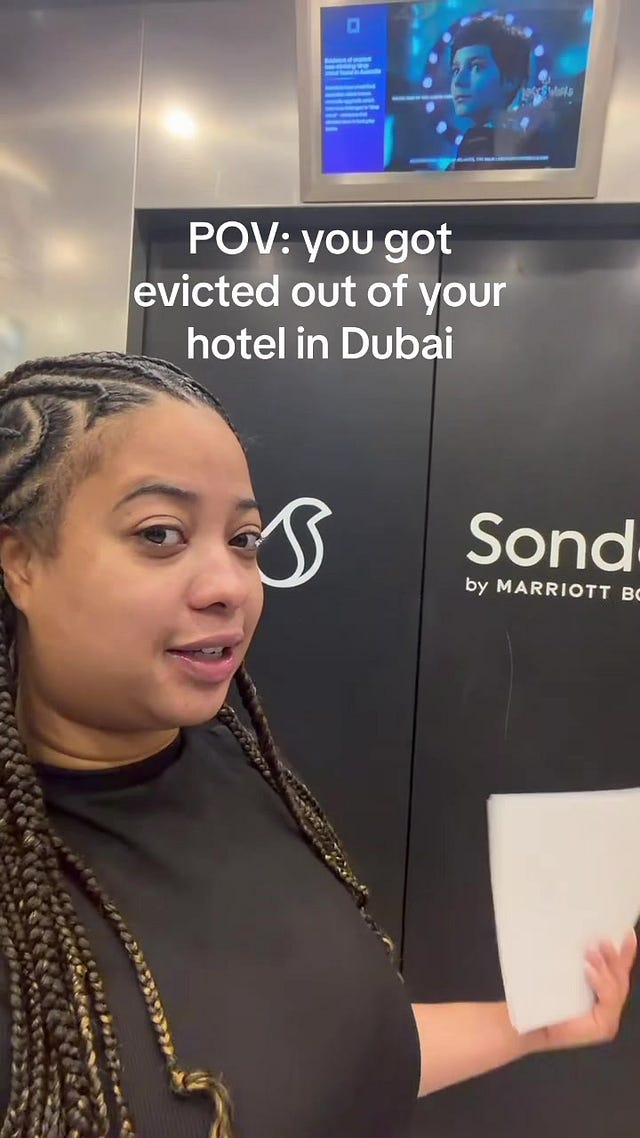
…Ok, not quite V for Vendetta but perhaps close enough. Supplementary video commentary below.
The promise of a seamless, tech-forward hospitality experience—a cosmopolitan apartment with the conveniences of a grand hotel—is, for the moment, dead. It died, with a shudder and a whimper, in the late autumn of 2025, when Sonder, the erstwhile billion-dollar disruptor, announced an immediate winding down of operations and a Chapter 7 liquidation. The death blow, however, was delivered just twenty-four hours earlier by the most formidable name in lodging: Marriott International.
Where to Begin, the Mirage of Disruption
For years, Sonder had been held up as a visionary counterpoint to the traditional hotel model. Founded in Montreal, the company staked its claim in the competitive urban landscape by signing long-term leases on thousands of apartment units, furnishing them with an eye toward minimalist chic, and managing them with an app-enabled ease that bypassed the friction of a front desk. It was an asset-heavy approach—unlike the purely intermediary model of its rival, Airbnb—that flirted dangerously with the cyclical woes of the real estate market, yet it was dressed up in the shimmering valuation of a technology firm.
In 2022, a successful public offering via a Special Purpose Acquisition Company (SPAC) seemed to validate the venture, but the company’s structural flaw—a model that accrued fixed costs faster than it generated free cash flow—began to betray its narrative. By 2024, losses mounted, and a lifeline was cast by the old guard: Marriott International. The licensing agreement, which brought thousands of Sonder units into the Marriott Bonvoy ecosystem, was meant to inject credibility, liquidity, and a flood of new bookings.
Yet, the very technology that was Sonder’s supposed strength became its undoing. Interim CEO Janice Sears cited “prolonged challenges in the integration of the Company’s systems and booking arrangements with Marriott International,” a euphemistic corporate phrase for a technical-operational disaster. These unexpected, mounting costs, coupled with a “sharp decline in revenue” tied to the Bonvoy system, ultimately led to a default, and Marriott, on Sunday, November 9th, 2025, pulled the plug.
Let’s dive into the Fatal Flaw
Sonder’s primary structural weakness was its asset-heavy, fixed-cost model, which fundamentally mismatched the high-growth, high-margin expectations of its technology valuation:
I. Fixed Lease Obligations (Inventory Risk): Unlike Airbnb, which operates a purely asset-light marketplace (taking a commission without owning or leasing any property), Sonder engaged in long-term master leases for thousands of apartment units and entire buildings. This required massive upfront capital investment in furniture, renovations, and lease security. Critically, it meant Sonder incurred fixed rental obligations whether a unit was booked or not. When occupancy lagged or market conditions soured, these fixed costs became an immediate and devastating drain on cash flow—a risk profile more akin to a traditional hotel chain, but without the benefit of owning the underlying real estate assets.
II. The Problem of “Tech-Washing”: Sonder pitched itself as a tech disruptor, but its core business was the notoriously low-margin, operationally complex business of property management and hospitality. The digital check-in and mobile-first experience were useful features, but they were not the fundamental engine of the business. The company’s valuation as a technology firm, which peaked around $2.2 billion via a 2022 SPAC merger, was a mirage that failed to account for the physical, unpredictable reality of leasing, cleaning, maintaining, and staffing thousands of units across dozens of cities.
III. Unsustainable Scaling: To justify the technology valuation and appease venture capital backers, Sonder pursued hyper-growth by continuously expanding its leased inventory. This demand for constant, expensive scaling outpaced its ability to generate operating profits, resulting in perennial and mounting net losses. The model demanded endless liquidity to feed its fixed-cost base.
Next Up: The Marriott Integration
The final, accelerated spiral toward Chapter 7 liquidation came directly from the failure of its last-ditch lifeline: the licensing agreement with Marriott International. In a newly published Business Insider article, Davidson himself noted that orchestrating this 20-year deal was “the hardest thing” he’d ever done, and it was the company’s attempt to gain stability and access to a vast, established distribution system — referring to Marriott ‘Bonvoy’.
The partnership struggled for two major reasons:
I. Technical Debt and Integration Costs: Aligning Sonder’s bespoke technology framework with Marriott’s legacy reservation systems proved to be far more complex and costly than anticipated. Sonder’s interim CEO cited “prolonged challenges in the integration... resulting in significant, unanticipated integration costs.” The complexity of the underlying operational business translated directly into technical failure.
II. Revenue Collapse: The integration issues led to delays in getting the full inventory effectively listed and bookable through the Marriott Bonvoy channel. This, combined with the royalty fees paid to Marriott, resulted in a sharp decline in net revenue at a moment when Sonder was desperately short on working capital.
Vacate the Premises Immediately
The corporate machinations that dissolved a multi-billion-dollar enterprise played out in the most unceremonious fashion for its clientele. The termination of the Marriott deal, which was swiftly followed by Sonder’s official bankruptcy announcement, was communicated to guests in a series of curt emails and text messages. The tenor of these communiqués was not of regret, but of mandate: vacate the premises immediately, or at least by Monday morning.
In New York, London, Boston, and Montreal, travelers on vacation, business trips, or extended-stay contracts received the digital equivalent of a note slipped under the door. A couple in the middle of a two-week stay in New York City found their reservation unilaterally canceled, and, like many others, were told to move out with less than a day’s notice.
The guests, many of whom had booked through the trusted Marriott portal, suddenly found themselves in a frantic, unassisted search for new accommodation. Attempts to contact either Sonder or Marriott yielded little beyond boilerplate apologies and defunct phone lines. As one stranded traveler lamented, replacement lodging cost double the rate of their original booking. They were left to bear the financial burden and the logistical nightmare alone, a testament to the cold indifference of an abrupt corporate implosion. The luxury of a premium, design-forward apartment was instantly replaced by the grim reality of a hurried packing job and an expensive taxi ride across a strange city.
The All in All
The episode serves as a cautionary tale not merely about the volatility of the tech-hospitality sector, but about the fragile contract between brand and consumer. When the edifice of a billion-dollar venture crumbles, the traveler, left standing with a suitcase on the sidewalk, is often the last to know and the first to suffer the cost.
Supplementary video commentary for added color. No affiliation with Pay Me in Plane Tickets, The Wapechi Collection.

 Tiktok failed to load.
Enable 3rd party cookies or use another browser
 Tiktok failed to load.
Enable 3rd party cookies or use another browser