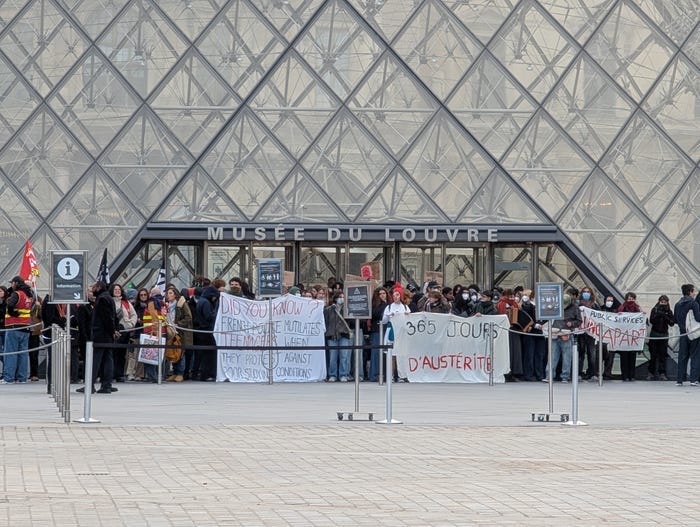

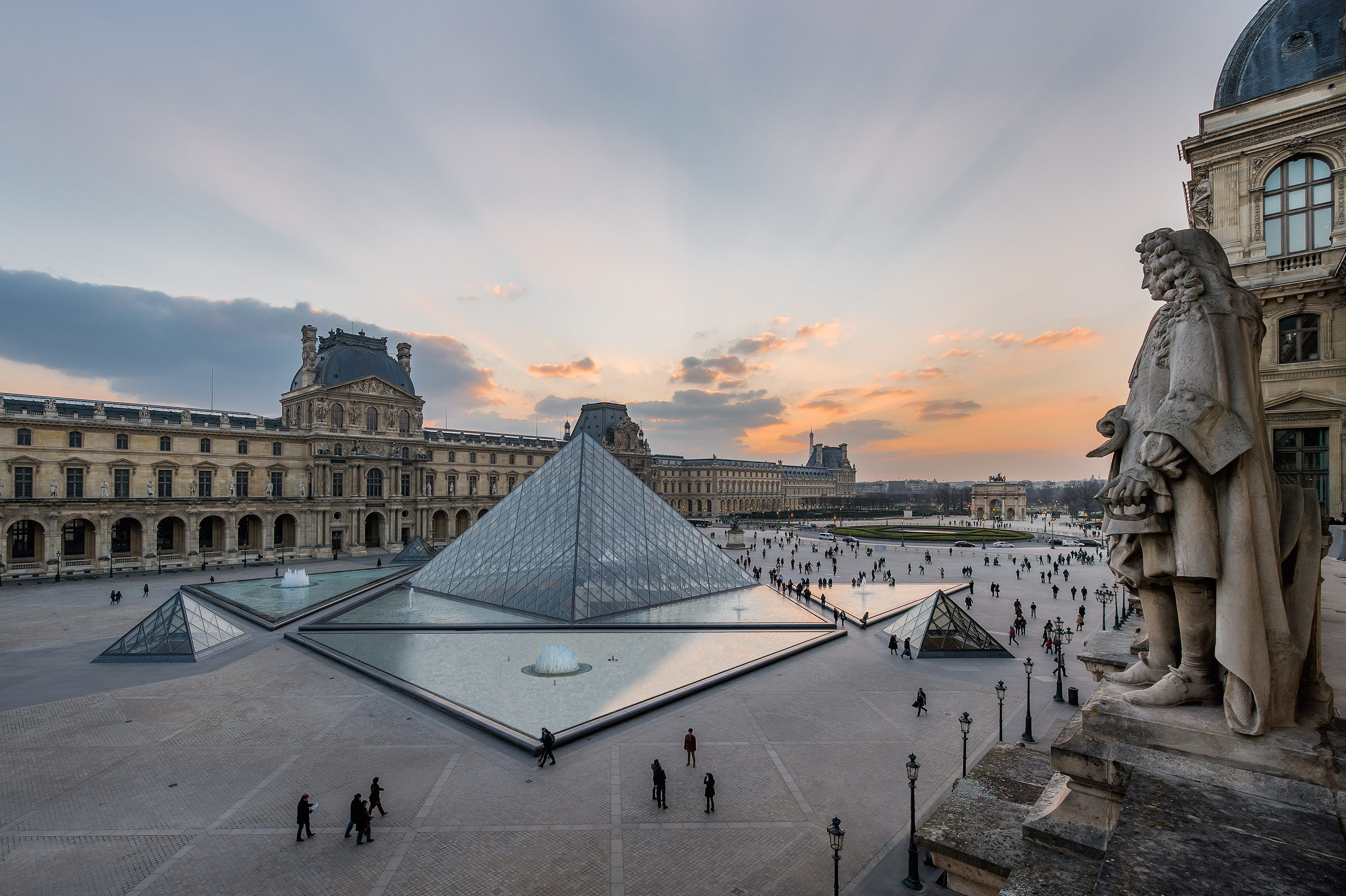
A particular kind of disappointment that belongs only to the tourist, and it was on display on the morning of Monday, October 19th, at the foot of I. M. Pei’s glass pyramid. People who had crossed oceans to stand before the Mona Lisa found the entrances to the Louvre sealed by barricades and by about fifty students from the École du Louvre, the art school that shares the palace grounds. The museum posted a two-line apology and sent everyone home. A few visitors, unable to reach Leonardo, offered the students their middle fingers instead, which is perhaps the most honest review of the experience anyone could have written.
The date had its own irony. It was a year to the day since thieves had strolled out of the Galerie d’Apollon with eighty-eight million euros’ worth of crown jewels, and France had spent much of that year asking how its greatest treasure house could be so easily breached. Now it was being breached by its own students, and not for anything inside. The Louvre reopened two days later, only to lock its gates again on Saturday the 24th, this time on the government’s orders, along with the Orsay, the Orangerie, the Picasso and the whole of the Tuileries. The paintings were never in danger. What was in danger, for a few strange days, was the idea of Paris itself: the city as an open door, a promise that the beautiful thing will be there when you arrive.
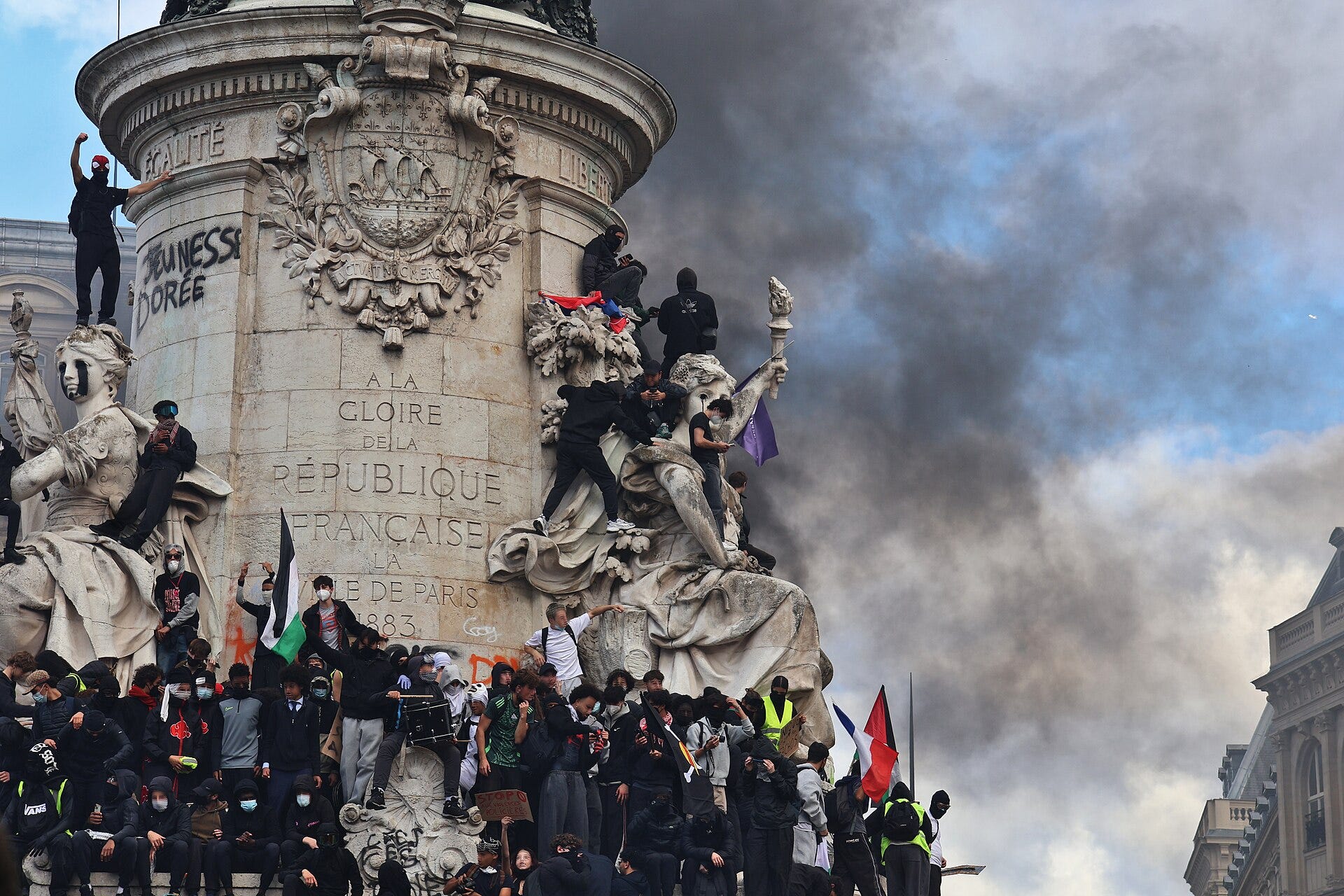
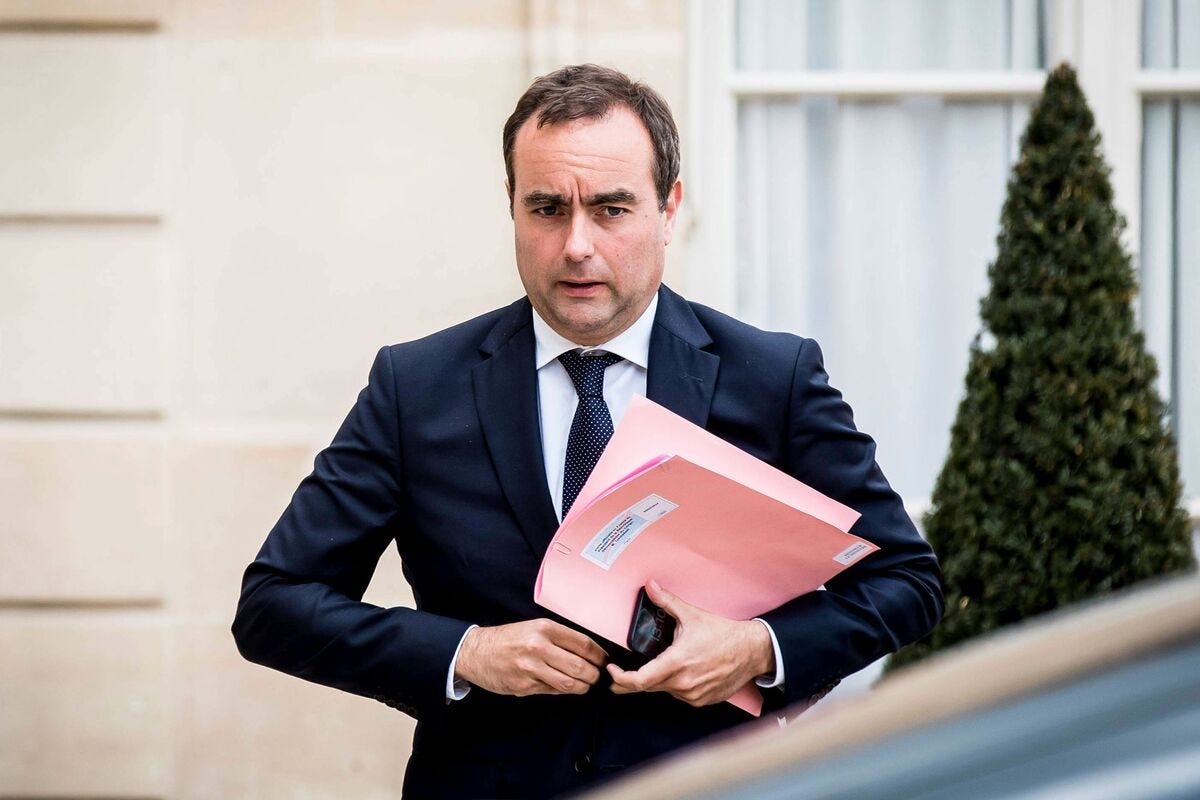
It is tempting to read the closures as theatre, and in France protest has always had a theatrical streak. But this uprising began somewhere unglamorous, with cold classrooms and broken radiators. In September, lycée students began blockading their schools over decaying buildings and a cost of living that had outrun their parents’ wages. University students joined them on October 1st. By the 17th, the unions, the old guard of the gilets jaunes, farmers and teachers had folded in behind the teenagers, and some 550,000 people marched across the country, 110,000 of them in Paris. That night town halls burned, luxury storefronts were stripped, and a police officer and a protester were dead. Emmanuel Macron went on television to condemn the “sowers of chaos.” His Prime Minister, Sébastien Lecornu, counted 1,200 arrests in a single day, and by the following Saturday the state had put 70,000 police and gendarmes on the streets and imposed curfews in several cities. It was the familiar French choreography of grievance and order, performed this time by children, before a lame-duck President, with an election in the spring that the far right believes is finally its to win.
Beneath the choreography lies arithmetic, and the arithmetic is unforgiving. France will run a deficit of about 5.4 percent of G.D.P. this year, nearly double the eurozone’s ceiling. Its public debt hovers near 119 percent of output and, by the finance ministry’s own reckoning, will reach 121.7 percent in 2027, a level not seen since 1978. On the day Lecornu presented his 2027 budget, the ten-year borrowing rate touched 4.94 percent, the highest since 2002. His answer is some 43 billion euros in cuts and other measures, built on a growth forecast that the country’s own fiscal watchdog considers optimistic, and it must pass a parliament with no majority, while fuel prices inflated by the war between the United States and Iran drain the same household budgets the marchers are defending. The bind is almost perfectly circular. To reassure its creditors, the state must spend less; to spend less is to provoke the street; and the street, televised, frightens away the visitors whose spending the state can least afford to lose.
Those visitors are not a sentimental concern. France receives roughly a hundred million of them a year, and they leave behind more than seventy billion euros. The people who house and feed them can price a riot with unsettling precision. Didier Arino, of the consultancy Protourisme, estimates that a single day of urban violence in central Paris erases about one percent of a month’s hotel nights. MKG Consulting watched it happen in real time: within a day, the booking lead that Paris hotels held for late-October stays shrank from a full point above last year to two-tenths of one, and the firm warned of lost reservations stretching six weeks out. The guests who flinch first, Arino notes, are the ones who travel farthest and spend the most, the Americans and the Gulf and Asian travellers who fill the palace hotels along the Rue de Rivoli. Art Basel Paris, which had sold a Gerhard Richter for $8.5 million on its first day, quietly cancelled its last two public days at the Grand Palais. Christelle Cassagne, who leads the national tourism body ADN Tourisme, described the scenes in Nice, Paris and Lyon as “catastrophic.” The planes kept landing at Charles de Gaulle. The trouble lay in everything between the runway and the lobby.
And yet the queue has come back, as it always does. The Louvre was shut for three days in all, and Paris hotel bookings, by most counts, still run ahead of 2025; Arino himself called the damage modest against the forty-two million hotel nights forecast for the year. The city has outlasted the gilets jaunes, the attacks of 2015 and the riots of 2023, and each time the line at the pyramid has reassembled itself, a little wary, then not wary at all. The more useful lesson for those in the business of selling Paris is not that the city is fragile but that its politics and its hospitality are now the same story. A government that must cut to calm the bond market will keep provoking the streets that unsettle its guests, and a presidential campaign will keep both on the evening news until May. The Mona Lisa, behind her glass, will be there in 2027. The question the trade will be answering, booking by booking, is whether the guest can reach her.