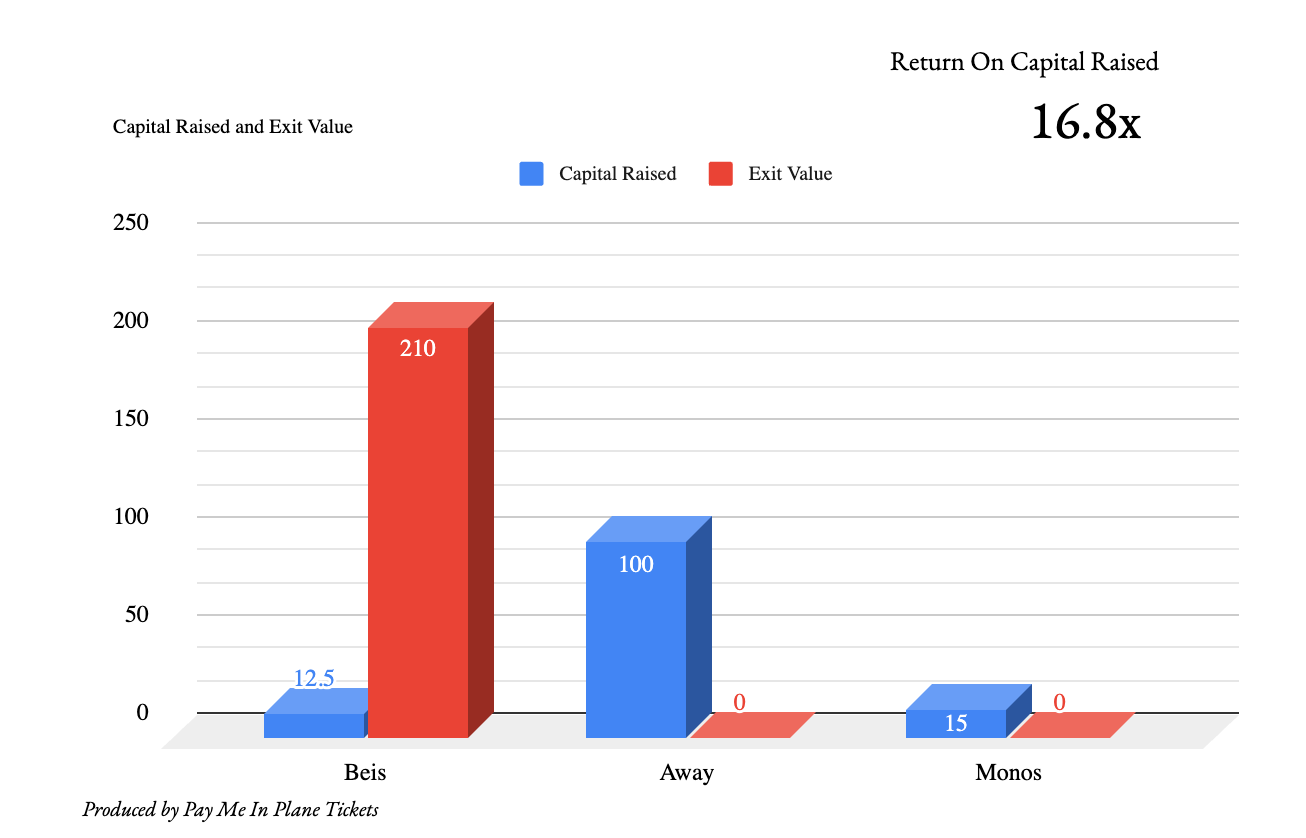

Nine years ago, “disruption” in the luggage category meant a millennial-pink box and a built-in phone charger. Today it means something closer to what Béis has built: a nine-figure, DTC travel brand that reached profitability almost immediately, raised a fraction of the capital its rivals did, grew revenue roughly tenfold in six years — from an estimated $20 million in 2019 to approximately $210 million in 2025 — and, on August 12, 2026, agreed to sell an 85 percent stake to Samsonite Group for $178.5 million in cash, at a total enterprise value of $210 million. Beach House Group, the incubator that built the brand alongside Mitchell and had held roughly 70 percent of the company, is exiting entirely; Mitchell will retain a 15 percent stake and continue as founder and creative director, while CEO Adeela Hussain Johnson stays on to run the brand as a standalone unit inside Samsonite’s portfolio. The deal is expected to close in the fourth quarter of 2026, pending regulatory approval.

The acquisition is worth dwelling on precisely because of who the buyer is. Samsonite is the incumbent whose century-old wholesale model Béis’s entire strategy was built to route around — the company that, through Samsonite, Tumi, and American Tourister, still commands roughly a fifth of the global luggage market and generates some $3.6 billion in annual revenue. That the largest legacy player in the category has now paid nine figures to acquire, rather than out-innovate, one of its DTC challengers is itself a verdict on the last eight years of the luggage business: distribution scale no longer beats digital-native brand equity, so incumbents are buying the equity instead. Béis is one of a small cohort of upstarts — alongside Away and Monos — that spent the past decade capturing meaningful share by exploiting a structural weakness in how legacy players sell luggage: through wholesale channels that add 40 to 50 percent in markup before a bag ever reaches a customer. Béis is now the first of the three to convert that share gain into an exit.
Béis was founded in October 2018 by the actress Shay Mitchell, in partnership with Beach House Group, the brand incubator run by PJ Brice and Shaun Neff that also built Millie Bobby Brown’s beauty line. Mitchell, who serves as Chief Creative Officer rather than CEO, has been candid that the company was never designed to be “Béis by Shay Mitchell” — a positioning choice that turns out to matter more than it sounds. It let the brand build equity independent of its founder’s fame, a hedge that Away, whose early identity was inseparable from its two co-founders, did not have when a 2019 report on its workplace culture damaged the brand’s standing.

That founder-distance is one of three structural decisions separating Béis from its two closest DTC rivals — decisions worth examining as a case study in category strategy rather than as competing lifestyle brands.
Away raised more than $100 million in venture funding on its way to scale and, by most accounts, took years to approach sustainable profitability, a common trade-off for DTC brands chasing growth-at-all-costs. Béis raised just $12.5 million and has reportedly been profitable since its earliest operations — an outcome achieved by keeping its cost base disciplined and by avoiding the marketing-spend arms race that inflated Away’s customer acquisition costs. Monos followed a version of Béis’s playbook, growing from $8 million in revenue in 2020 to over $150 million in 2024 while remaining comparatively capital-light.
Away spent years as a DTC-only brand before diversifying; Béis launched into Nordstrom on day one, hedging its digital-native identity with wholesale credibility and physical retail exposure from the start. Monos took a middle path, opening a small footprint of five U.S. stores — in Boston, Los Angeles, Chicago, New York, and Washington, D.C. — while shipping the bulk of its inventory directly from contract manufacturers, cutting delivery times to seven to ten days versus the 30 to 45 days legacy retailers absorb through container shipping. Each brand, in other words, chose a different point on the spectrum between digital purity and physical presence, and each bet has paid dividends differently: Away’s early DTC-only stance built brand mythology but limited discovery; Monos’s lean store footprint builds tactile trust in a category where customers want to touch the product before buying; Béis’s day-one wholesale play sacrificed some DTC margin purity for faster, broader reach.

 Tiktok failed to load.
Enable 3rd party cookies or use another browser
Béis prices its carry-on at $218, meaningfully below Away’s $295, while pushing new collections — totes, backpacks, diaper bags, gym bags — at a cadence closer to a streetwear label’s drop calendar than a traditional luggage company’s seasonal reset. That velocity does two things a slower catalog cannot: it keeps the brand perpetually fresh in a feed-driven purchase environment, and it de-risks the business from any single product’s durability complaints by diversifying revenue across dozens of SKUs. When durability criticism surfaced on social media, Béis converted the complaint into content and revenue rather than crisis management, launching the Béis Wash, a free luggage-cleaning pop-up that reportedly became one of its highest-grossing events of the year — a marketing instinct neither Away nor Monos has replicated at the same scale.
For years, the assumption in DTC luggage circles was that these companies were building toward an IPO, à la Away’s abortive 2021 flirtation with going public, or toward indefinite independence, à la Monos’s continued private growth. Béis’s outcome — an acquisition by the exact incumbent its strategy was designed to undercut — suggests a third, more pragmatic model: build a capital-efficient, profitable brand with a loyal following, then sell the growth engine to a company that already owns the sourcing infrastructure, international distribution, and manufacturing scale a DTC brand would otherwise spend a decade building on its own. Samsonite’s own language around the deal is telling: the company says it expects the transaction to have minimal near-term impact on profitability, with efficiencies to be realized over time as Béis “gains access to Samsonite’s scale, sourcing capabilities and global infrastructure” — an admission that Béis had already solved the harder problem, brand and demand, and simply needed the industrial back end that Samsonite has in abundance. Lifestyle bags, notably, account for roughly half of Béis’s sales, meaning Samsonite isn’t just buying a luggage brand; it’s buying entry into the adjacent bag categories — totes, backpacks, diaper bags — that traditional luggage makers have struggled to crack.
For Away and Monos, the deal changes the competitive calculus. Away, still independently owned and still working to rebuild the brand equity dented by its 2019 controversy, now faces a rival with the balance sheet of the industry’s largest player behind it — Béis’s marketing budget, sourcing costs, and international shelf space could all improve materially once Samsonite integration begins. Monos, which has pointedly stayed capital-light and founder-controlled, becomes the most conspicuous holdout among the three, and the one now most likely to be read by the market as the next acquisition target, whether by Samsonite or a rival like VF Corporation or Compagnie Financière Richemont, both of which have circled premium travel brands in recent years.
The durability question that has dogged all three DTC challengers — independent testing in 2026 found none of them yet matches the multi-decade warranty record of an old-guard brand like Travelpro, and that the “lifetime warranty” language common to Away, Monos, and Béis alike routinely produces discount offers rather than true no-questions-asked replacement — may turn out to be the deal’s quiet rationale. Samsonite’s engineering and supply-chain depth is precisely what could close that gap for Béis in a way no amount of Instagram spend could. Whether that turns Béis into the category’s most credible full-stack challenger, or whether the acquisition slowly sands off the founder-led scrappiness that built the brand’s following in the first place, is the question that will determine whether this deal reads, in five years, as Samsonite’s smartest acquisition or its most expensive attempt to buy a culture it can’t actually absorb.