
In the theology of the American hotelier, the guest is a sacred figure. Whether they arrive with a Louis Vuitton trunk or a weary sigh, the transaction is meant to be a simple one: currency for sanctuary. But this winter, in the frozen suburbs of Minneapolis, that ancient pact has begun to thaw, revealing a jagged, political undercurrent.
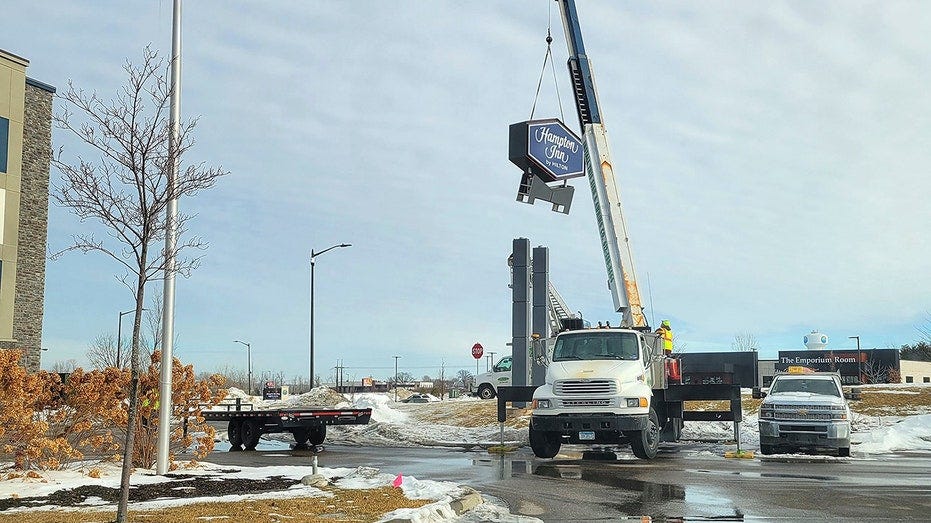
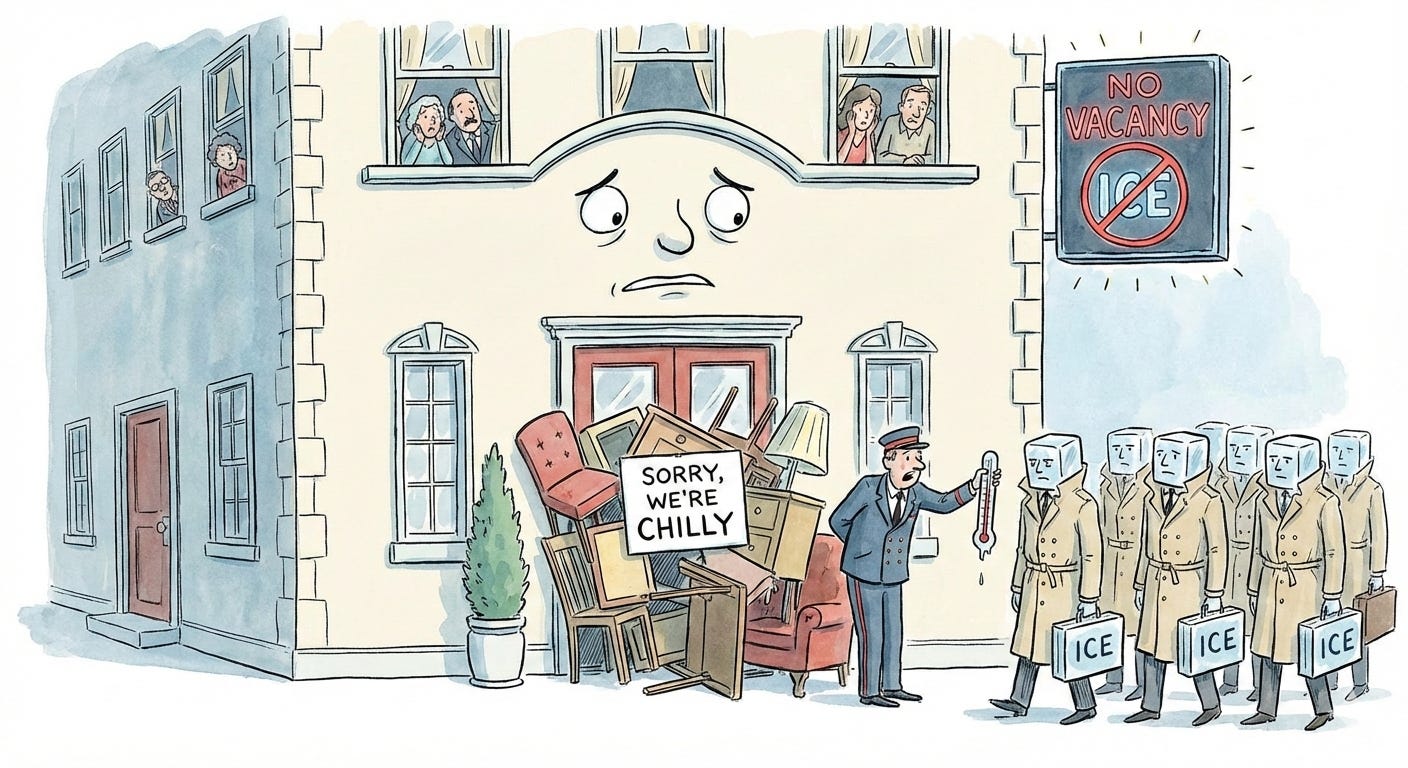
Last week, a Hampton Inn in Lakeville, Minnesota, became the unlikely ground zero for a movement that is forcing the industry to redefine what it means to keep an “open door.” The “No Rooms for ICE” campaign, a loosely coordinated effort of local activists and national organizers, has moved from the streets to the lobby, pressuring hotel owners to deny lodging to federal agents. It is a movement that treats the hotel room not as a commodity, but as a moral complicity.
The Midnight Check-In
The incident that rattled the industry began with a viral video—a staple of our modern, performative justice. A conservative influencer, posing as a Department of Homeland Security official, attempted to book a room, only to be told by a desk clerk that the property was no longer accepting the reservation. Within forty-eight hours, the machinery of the state and the market responded with surgical precision. Hilton, the global brand under which the hotel operated, stripped the property of its franchise status, effectively exiling it from the digital ecosystems of Booking.com and Expedia. The General Services Administration (GSA) followed suit, blacklisting the hotel from all government travel programs.
For the owner, Everpeak Hospitality, the decision to turn away the state was an act of sudden, catastrophic friction. In trying to avoid the “No Sleep” protests—where activists gather outside hotels with pots, pans, and megaphones to ensure that enforcement agents get no rest—they instead found themselves in a different kind of darkness: a financial void.


The Architecture of the Arm’s Length
To an owner like Tyler Morse of MCR Hotels, the third-largest operator in the country, the hotel is a machine for efficiency. But the “No Rooms” movement challenges the very neutrality that the industry depends on. For decades, hotels have been the quiet infrastructure of American enforcement—housing agents during surges, providing staging grounds for raids, and, more controversially, serving as makeshift holding cells when official facilities overflow.
When a hotelier accepts a government contract, they are participating in what scholars call “state-adjacent” architecture. The room is no longer just a bed; it is a cell, a headquarters, a piece of the border moved inland.
“We are being asked to choose between the law of the brand and the conscience of the neighborhood,” says one boutique owner in Chicago who recently faced similar pressure. “If I host the agents, I lose my staff and my local regulars. If I don’t, I lose my franchise and my insurance. There is no neutral room anymore.”
The Moral Calculus of the Keycard
The dilemma is particularly acute for the “creative” hotel brands—the ones that sell an ethos of inclusion and global citizenship. To market a hotel as a “home for everyone” while simultaneously billing the federal government for the lodging of those who deport “everyone” is a cognitive dissonance that activists are no longer willing to ignore.
The “No Sleep for ICE” movement is, at its core, an attempt to make the cost of enforcement visible. By turning the hotel lobby into a site of protest, they are forcing owners to do a new kind of math. Is the guaranteed revenue of a government block-booking worth the reputational risk of being labeled a “detention partner”?
Let’s game theory the paradigms

The End of the Neutral Space
As the snow continues to pile up in Lakeville, the stripped-down Hampton Inn stands as a silent monument to this new reality. It is a hotel without a name, a business without a network. It attempted to draw a border at its own front desk, and in doing so, it found itself on the wrong side of both the state and the market.
The hospitality industry has long thrived on the illusion that it exists outside of history—that the lobby is a bubble of climate-controlled peace. But as the “No Rooms” movement gains momentum in cities from Portland to Charlotte, that bubble is bursting. The hoteliers are learning what the rest of us have known for a long time: when the border moves, it doesn’t stop at the gates of the city. It knocks on the door and asks for a key.