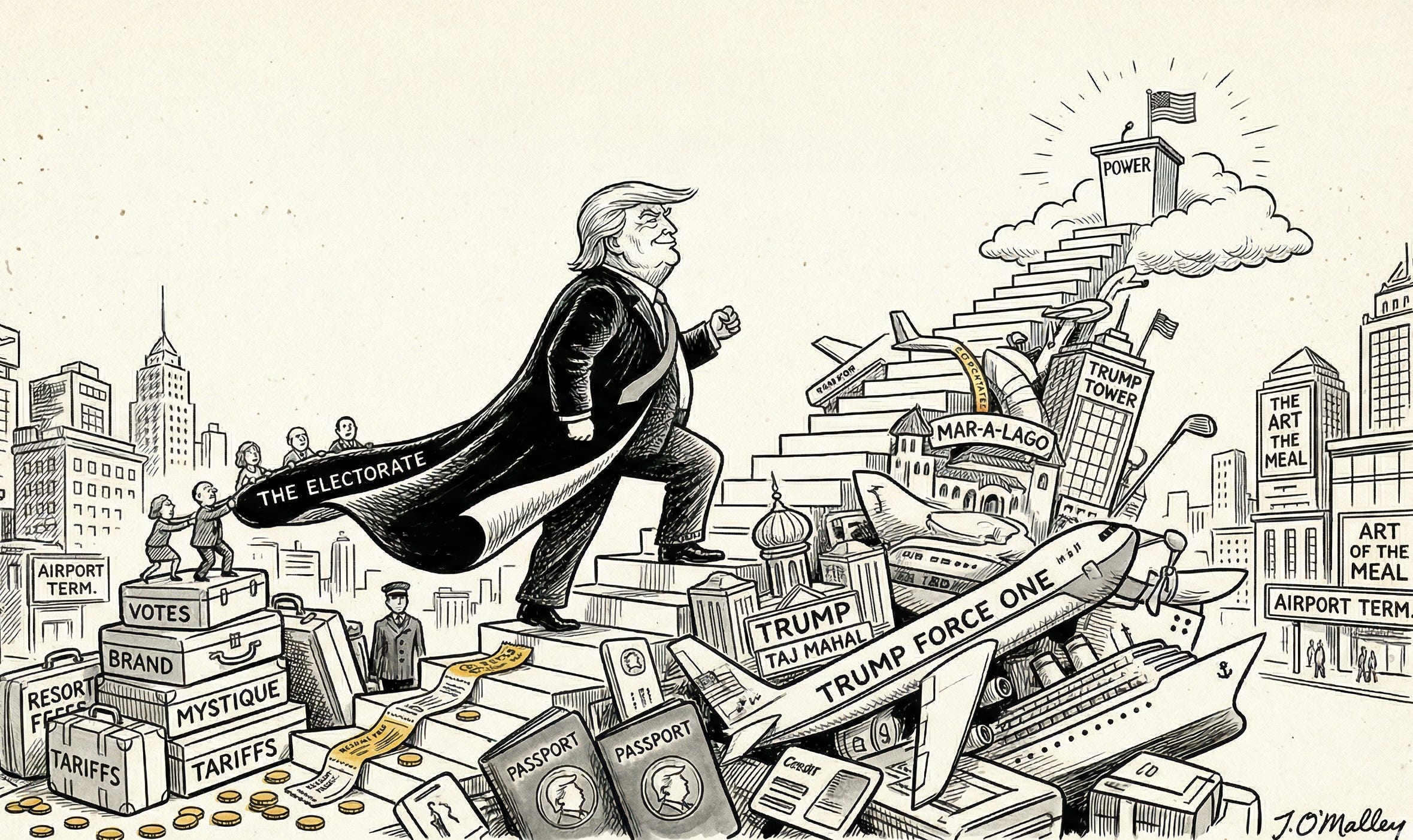

Donald Trump’s ascent to the presidency was not merely a political phenomenon; it was a masterclass in brand-leveraging born from the travel and hospitality sectors. While traditional politicians rose through the ranks of law or community organizing, Trump utilized the physical and symbolic architecture of global travel—hotels, casinos, and private aviation—to construct a persona of the ultimate executive.
Today, as his administration navigates its second year in 2026, the very industry that served as his springboard finds itself caught in the crossfire of his America First protectionism.
Let’s Examine A Timeline of Travel-Driven Influence
The travel sector provided Trump with two things traditional politics couldn’t: visibility and perceived competence. By attaching his name to the skylines of the world, he bypassed the need for a political resume.
1976–1980: The Grand Hyatt Breakthrough
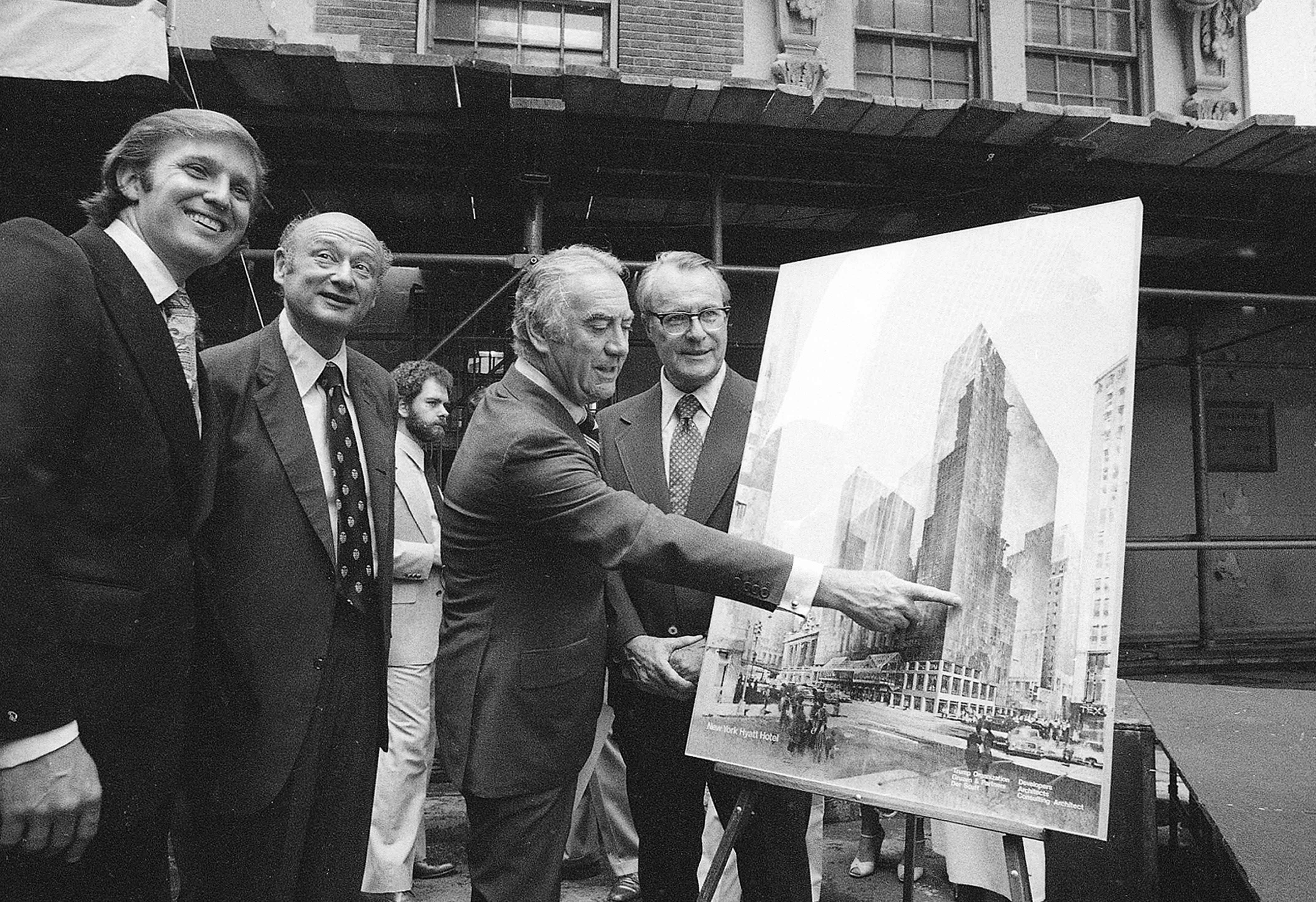
Trump’s first major Manhattan deal involved the Commodore Hotel. By partnering with Hyatt, he proved he could navigate complex city tax abatements and construction, turning a decaying transit hub into a glass-clad symbol of luxury. This established his “fixer” reputation. Eventually Trump sold his possession for an estimated $140M in 1996.
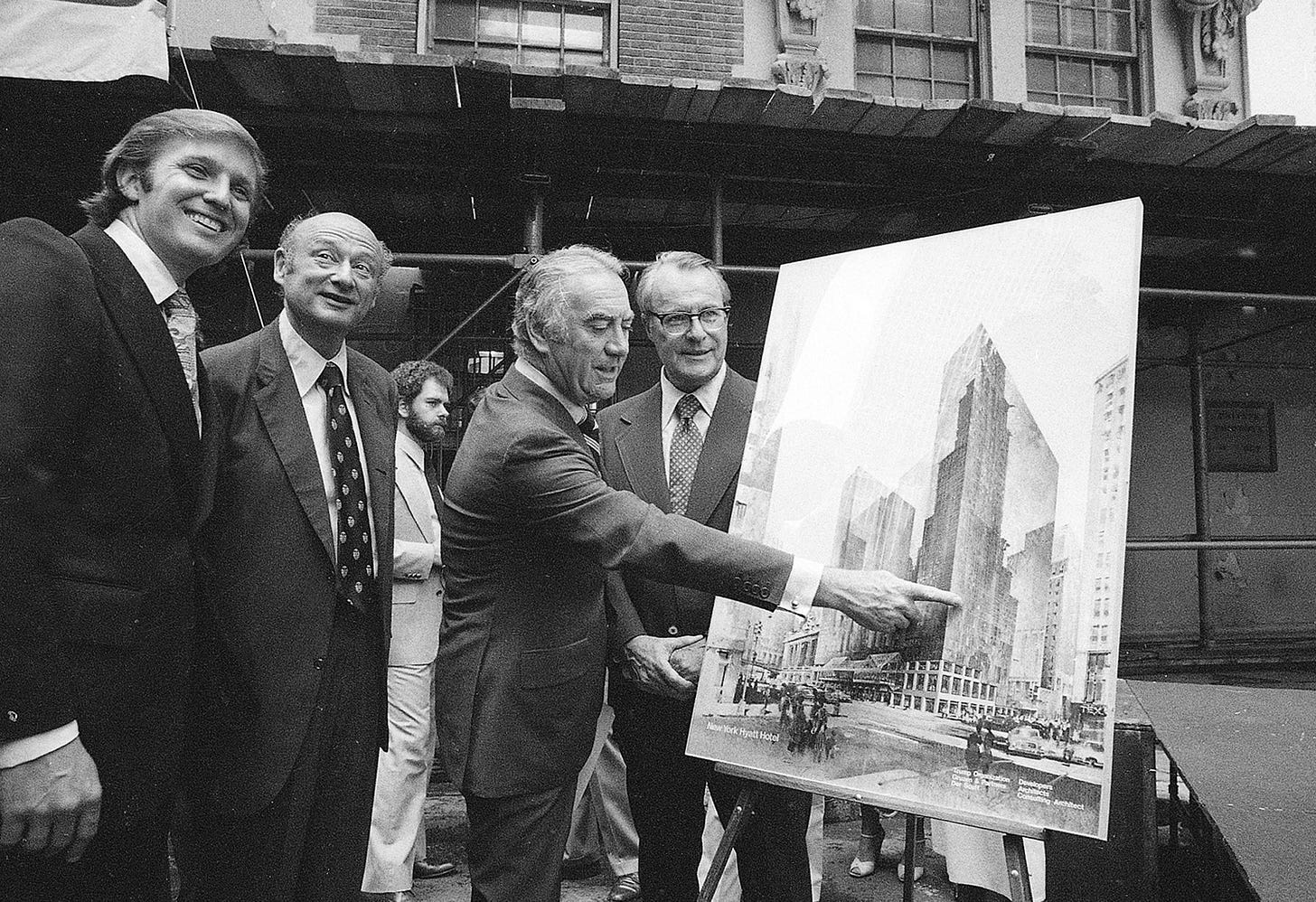
Commodore Hotel, 1919 | Grand Hyatt New York 1979 1984–1990: The Atlantic City Empire
Through the opening of Harrah’s at Trump Plaza (1984), Trump Castle (1985), and the “eighth wonder of the world,” the Trump Taj Mahal (1990), Trump became synonymous with the “destination” lifestyle. Even as these entities faced multiple Chapter 11 bankruptcies, the public associated him with high-stakes winning.
2004–2015: The Licensing Pivot
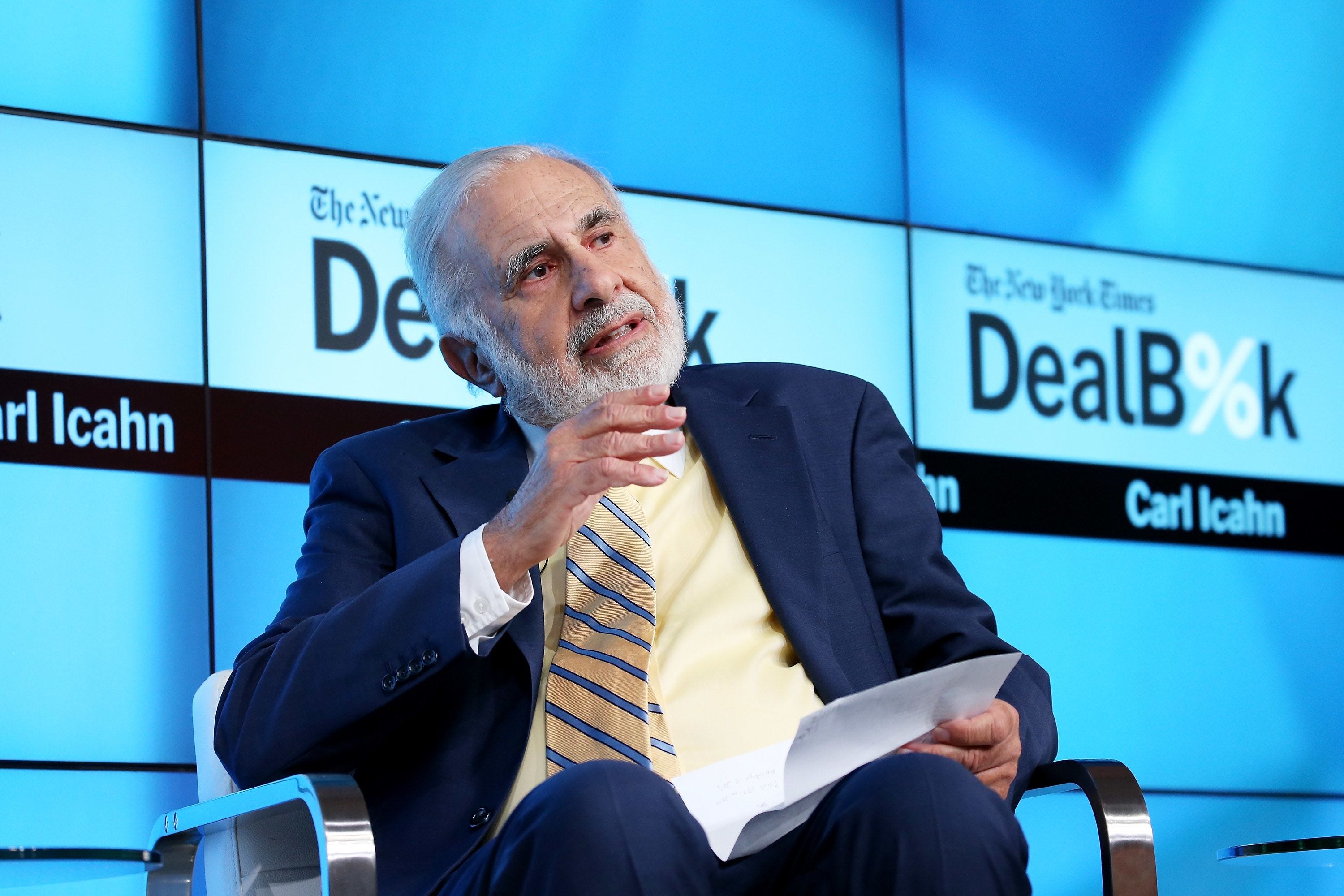
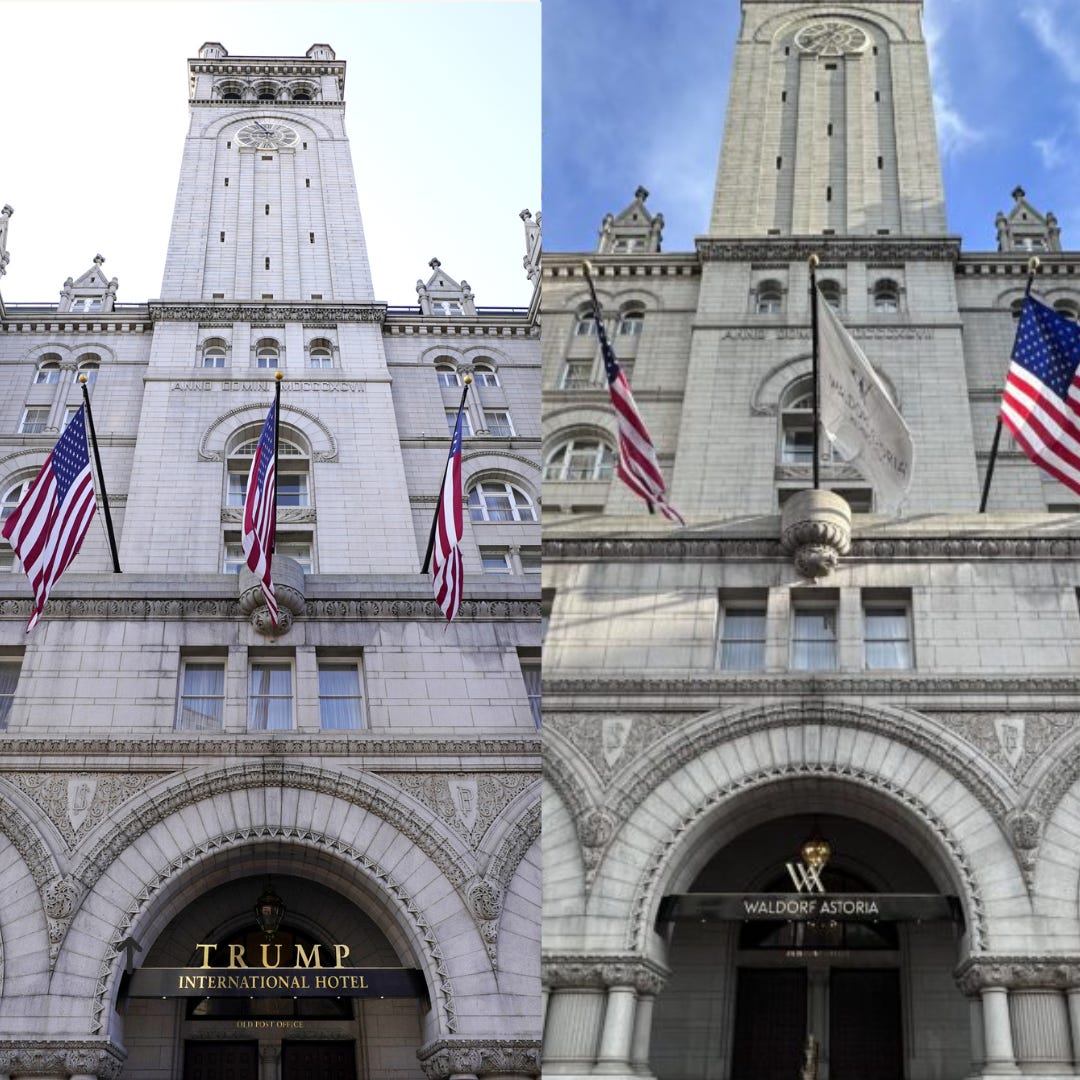
Following financial turbulence, Trump shifted from owning to licensing. The travel sector became a billboard. From Waikiki to Panama, “Trump Hotels” created a global footprint. This period was crucial; it allowed him to project global influence without the liability of operational failure. “Trump Hotels” went defunct in 2016 after filing for three bankruptcies in both 2004, 2009, and 2014 and a Icahn Enterprises acquisition. Effectively Carl Icahn, infamously known for being a corporate raider, financially rescued Trump’s persona and gravitas.
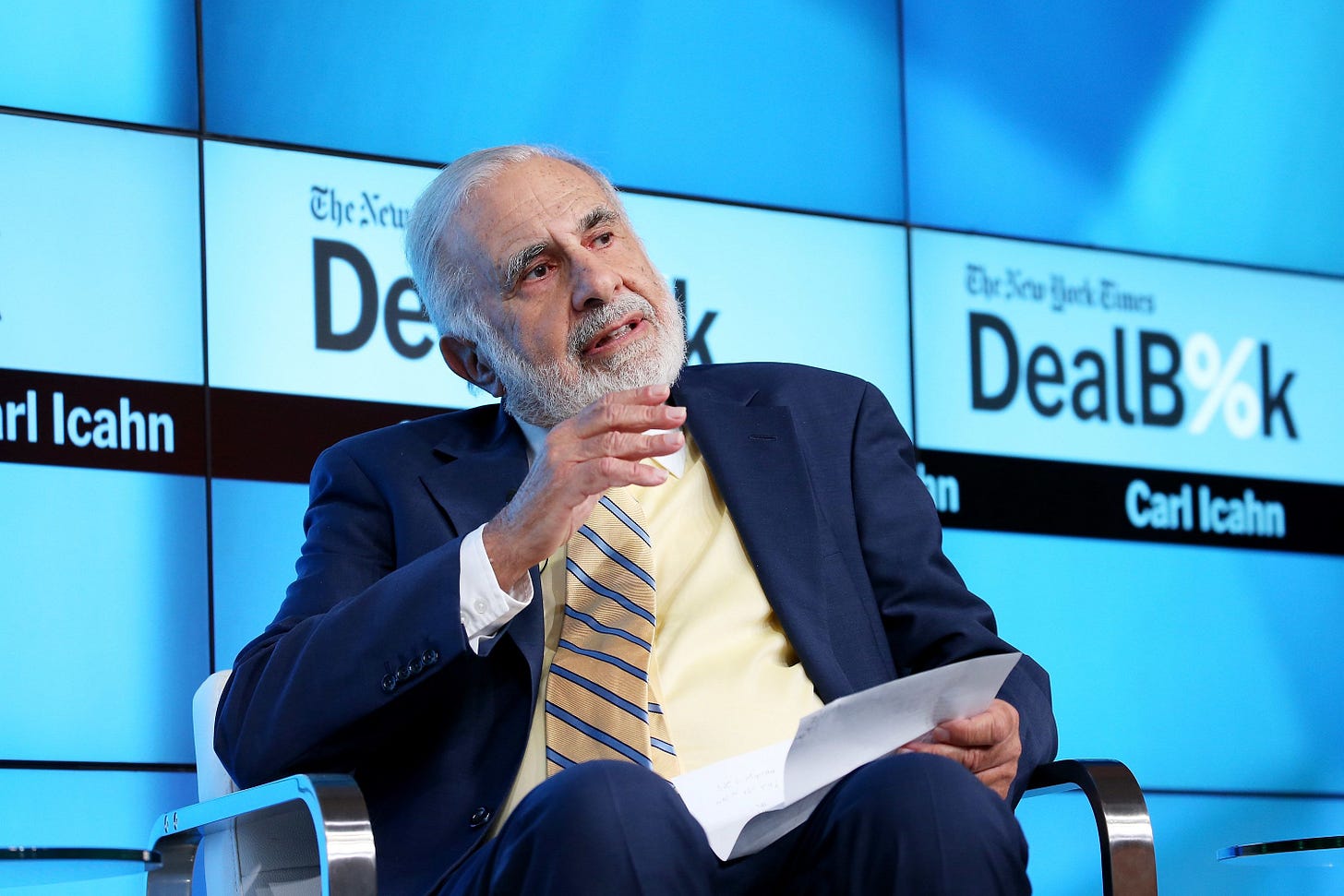
Carl Icahn at 2015 DealBook Conference 2016: The Campaign Trail as a “Tour”
During his first run, the “Trump Force One” Boeing 757 became a central character. It was more than a plane; it was a mobile monument to his success in the travel world, contrasting his private-sector “opulence” with the “stagnation” of the public sector.
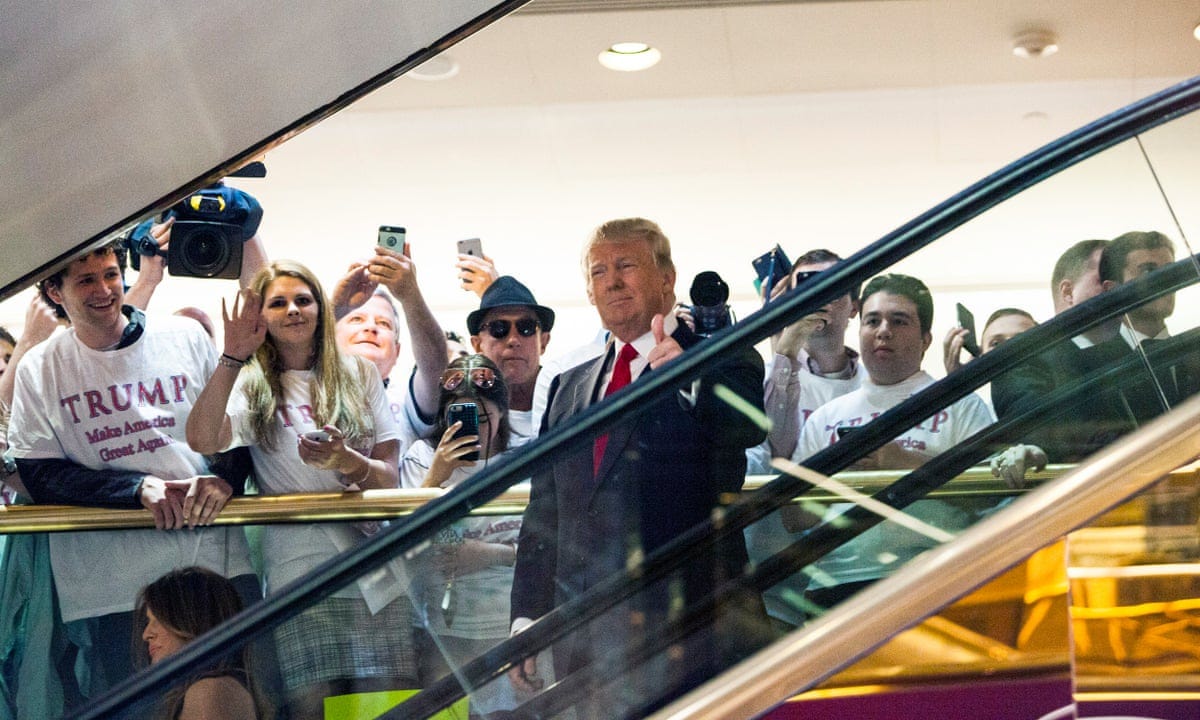
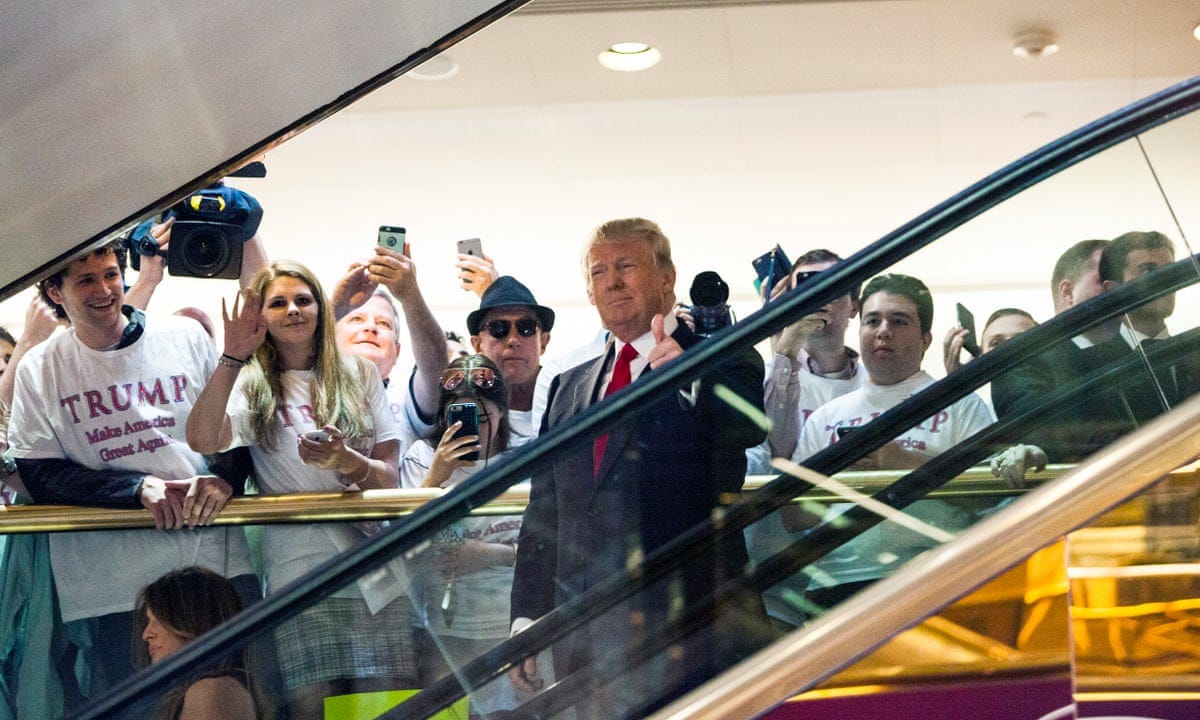
Trump descending on the elevator at Trump Hotel in Manhattan in 2015

Based when Trump filed his first Personal Financial Disclosure (PFD) with the Federal Election Committee (FEC) in 2015, he reported significant income (often gross revenue rather than net profit) from the following sources:
Golf/Resorts: $176M+ (Trump Doral Miami was the largest contributor)
Miss Universe: $3.4M (prior to selling his stake later that year)
The Apprentice: $213M (total over the lifetime of the show, according to his campaign)
Book Royalties: $50k - $100k (Art of the Deal)
It would corroborate that the hospitality sector contributed to the wealth of the enterprise and further, D.J. Trump.
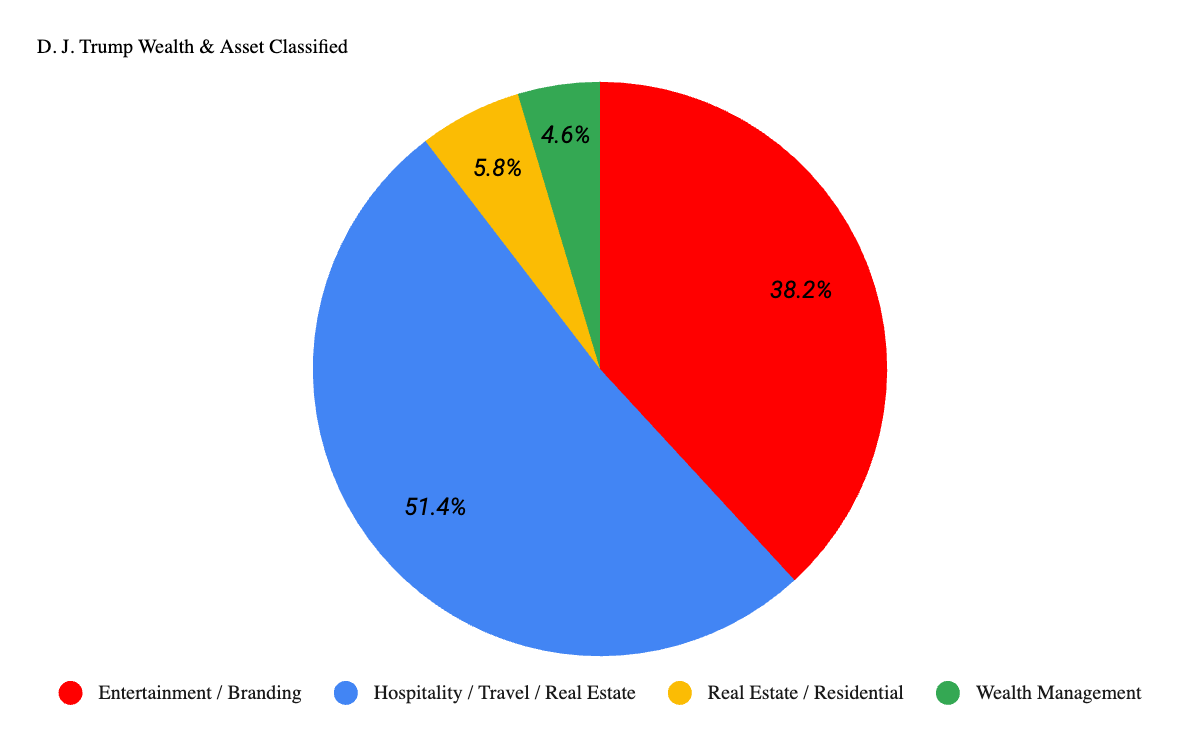
The $3.3 billion valuation of Donald Trump’s NIL (name, image, and likeness) is arguably the most controversial line item in his 2015 financial narrative. To understand it, one must look at it not as a bank balance, but as a projected intangible asset. In financial accounting, this is often referred to as “Goodwill,” but Trump’s team calculated it through a more aggressive lens of future licensing potential.
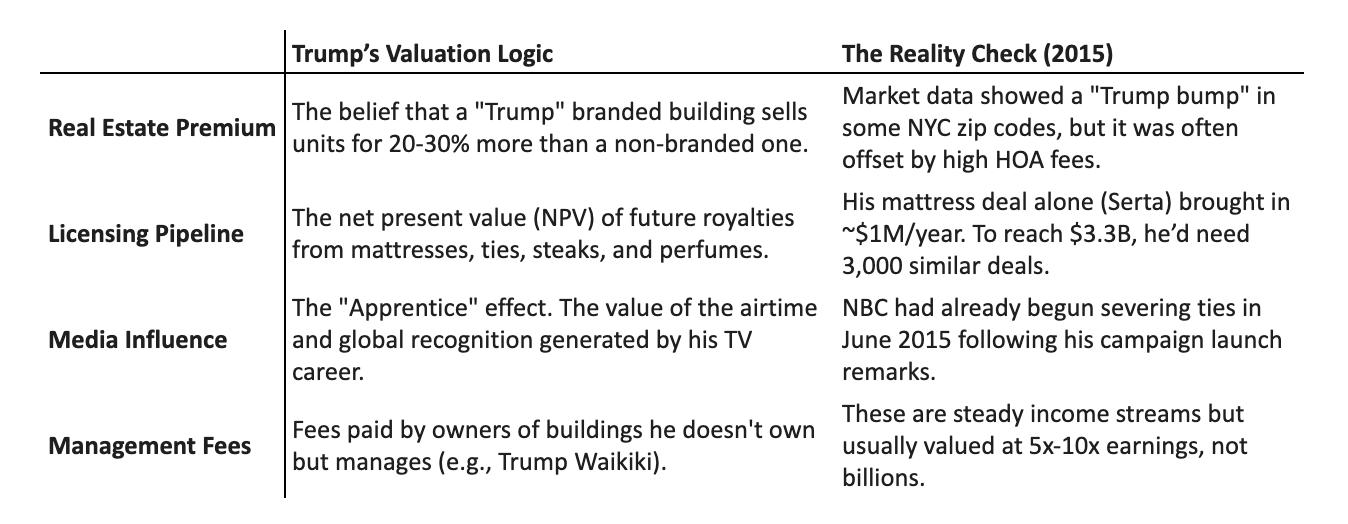
Why This Valuation Was Critical to His Rise
The $3.3 billion figure wasn’t just vanity; it was a strategic political tool.
1. The Success Benchmark: By valuing his brand so high, he created a “floor” for his reputation. Even if his buildings were leveraged, his name was presented as an indestructible asset that could not be foreclosed upon.
2. Psychological Warfare with Media: For decades, Trump lobbied Forbes writers to increase his ranking. In 2015, the $3.3B claim was a direct challenge to their methodology. He understood that in the attention economy, being perceived as the richest man in the room was more valuable than actually being the richest.
3. The Travel Sector Pivot: This brand value allowed him to transition from a builder (who takes massive capital risks) to a licensor (who takes almost zero risk). In the travel space, he sold “The Trump Lifestyle” to developers in India, Turkey, and the Philippines, collecting fees just for putting his name on the door.
The “Brand Trap”: A Critical Reversal
As of 2026, we can see the flaw in the $3.3B valuation — Brand equity can become negative.
Partisan Polarization: In 2015, the brand was “Luxury.” By 2026, the brand is “Political.” This has alienated the very demographic (high-net-worth international travelers) that fueled his licensing revenue.
The Forensic Reality: During the New York civil fraud trial (concluding in 2024), it was revealed that his Statements of Financial Condition frequently used these inflated brand numbers to secure better loan terms from Deutsche Bank, even though the bank’s internal analysts often “haircut” (reduced) his reported brand value by 50-75%.
From a journalistic & financial point of view, Trump’s $3.3 billion brand was a faith-based asset. It existed as long as the public and lenders believed in the myth of the Midas touch. Once he entered the political arena, he traded commercial brand value (universal appeal) for political brand equity (niche but intense loyalty).
To put his $3.3 billion claim in perspective, here is how it compared to other major global brands at the time, 2015:
Donald Trump (Self-Valuation): $3.3B
Starbucks (Brand Finance 2015): ~$9B
Four Seasons Hotels: ~$1B ~ (PMIPT estimated brand component)
Forbes Valuation of Trump Brand: ~$125M
Trump essentially argued that his name alone was worth more than three Four Seasons chains, a claim that the travel industry is still grappling with today as they decide whether to remove or retain his name on licensed properties.
The Critical Assessment
Now back in the White House, Trump’s relationship with the travel sector has turned from symbiotic to arguably parasitic. While he uses the industry’s infrastructure to project power, his current maneuvers are systematically dismantling the global “openness” that travel requires to thrive.
1. The “Border-Industrial Complex”
The 2025 executive orders focusing on mass deportations and “negative net migration” have had a chilling effect. By repurposing travel technology—like the CBP One app—into tools for self-deportation, the administration has rebranded the “gateways” of America as “checkpoints of expulsion.”
2. The Tariff Turmoil
His 25% tariffs on Canada and Mexico (early 2025) didn’t just affect goods; they affected sentiment. Data from 2025 shows Canadian visits to the U.S. plunged by over 23% by air and 30% by car. For a sector that relies on the “welcome mat,” Trump has effectively hung a “closed” sign. See The Vanishing Welcome Mat
3. Integrity Visas
The introduction of mandatory “integrity fees” ($250 per visa) and extreme vetting of social media has caused international visitor spending to dip 5.5% in late 2025. Critics argue this is a “soft ban” that targets global exchange in favor of isolationist purity.
Recent metrics indicate that the brand of American Hospitality is eroding under the current administration’s rhetoric:

Fostering a New Generation of Leaders
For the most part, many leaders in the travel sector are considerate of all angles in the travel playground although the rise of Trump proves that the travel sector can produce leaders with high visibility but often low accountability for global stability. To properly foster leaders for the next generation, many suggest prioritizing diplomatic training. Leadership in travel should require a background in international relations, not just The Art of the Deal. Understanding the nuance of cross-border movement is a security skill, not just a business one. Secondly, institutionalize citizen diplomacy, where travel CEOs must view themselves as de facto ambassadors. Organizations like the Global Tourism Forum (GTF) should create fellowships that train leaders to balance profit with the preservation of “global access. Lastly, value resilience over opulence where the next generation of travel leaders needs to be judged on how they handle crises (pandemics, climate shifts) rather than how many floors they can build.
The travel sector gave Donald Trump the stage to reach the world. Now, the travel sector must decide if it will remain a passive backdrop or become the force that reopens the doors he is currently closing.