


In the quiet, dusty corridors of a roadside clinic or the lush, humid stretches of a Thai sanctuary, the traveler often carries a dual burden: the weight of their own privilege and the literal weight of a camera. We often think of photography as a means of “taking”—a capture, a shot, a framing of reality. But for photographers like Cade Martin, the camera has ceased to be a tool of extraction and has become a mechanism of deep, radical empathy.
To look through a viewfinder is to practice a specific kind of disciplined attention. In Martin’s work, this discipline transforms the casual observer into a vital witness, one who seeks not just the “unique moment,” but the redemptive one.
Listen to Cade Martin on Pay Me In Plane Tickets Radio
The Geometry of Shared Humanity
The humanitarian lens is not born from capturing misery; it is born from recognizing dignity where the world has habituated itself to looking away. Travel provides the friction necessary to wear down our preconceptions. For Martin, navigating unfamiliar geographies isn’t just about the travelogue; it is about a recalibration of the soul.
Nowhere is this more evident than in his documentation of The Wheelchair Mafia. At an animal sanctuary in Thailand, Martin encountered a community of stray, abandoned, and injured dogs who, despite their physical brokenness, possessed a kinetic, infectious joy. By framing these “second chances,” Martin’s photography does something more than report—it advocates.
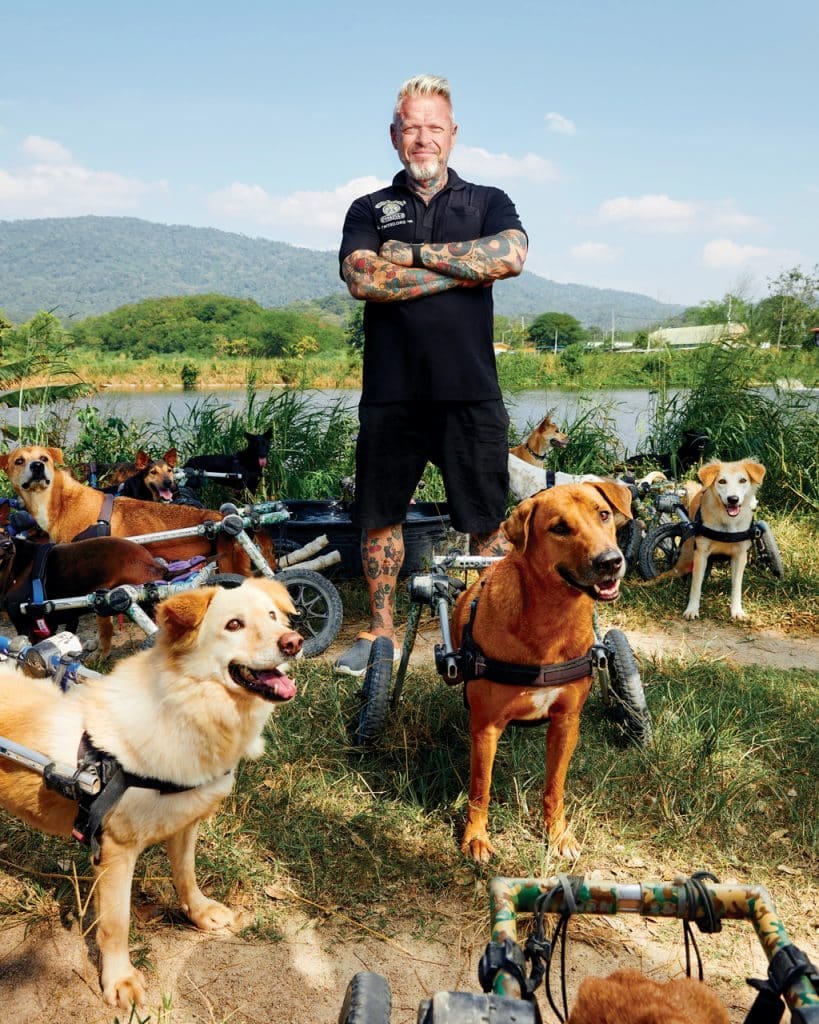
“If your pictures aren’t good enough, you aren’t close enough,” Robert Capa famously remarked. In the humanitarian sense, “closeness” is not merely physical proximity; it is the spiritual alignment required to see a paralyzed dog not as a tragedy, but as a survivor.
The Shift from Subject to Participant
The Observer Effect: Martin’s approach acknowledges that the presence of the photographer changes the room. By engaging with humanitarian projects, he moves beyond the “decisive moment” into a sustained dialogue with his subjects.
The Narrative of the Underdog: In the Thai sanctuary, the lens focuses on the mechanical grace of the wheelchairs against the vibrant green of the landscape. It is a visual metaphor for resilience: the intersection of human ingenuity and animal spirit.
The Ethics of the Frame
Travel forces us to confront the reality that “the other” is a fiction of distance. Whether Martin is capturing the high-fashion pulse of a city or the rhythmic barking of a rescue pack in Southeast Asia, his “humanitarian lens” remains consistent. It is an insistence that every subject is entitled to the “Golden Hour.”
Why the Image Matters in 2026
In an era of AI-generated hyper-reality, the authentic photograph—born of sweat, jet lag, and genuine connection—is a rare currency. It functions as a “proof of life” for the forgotten.
Contextualization: Martin’s travel allows him to understand the why behind the what. A photo of an injured animal is a plea; a photo of that same animal racing through the grass on wheels is a manifesto of hope.
Accountability: The lens holds the viewer to account. By showcasing the success of these projects, Martin turns the traveler’s private journey into a public call to action, proving that “giving back” is the most enduring image one can capture.
The Weight of the Return
The true shaping of the humanitarian lens happens not when the shutter clicks, but when the traveler returns. To have seen the world through Martin’s eyes—where a “Wheelchair Mafia” can reclaim their mobility—is to lose the ability to remain indifferent.
The photograph becomes an artifact of a changed conscience. It reminds us that the world does not need more tourists; it needs more witnesses who are willing to frame the world’s pain with the same grace they afford its wonders. In the end, Cade Martin’s journey suggests that we don’t just take pictures; we carry the light of those we’ve met back into the shadows of our own complacency.
Given your interest in Martin’s work with The Wheelchair Mafia, are you more drawn to the technical challenge of shooting moving subjects in high-stakes environments, or the ethical storytelling involved in animal advocacy?