


The club met on Sunday mornings, before the mopeds thickened into gridlock: a few dozen foreigners in neon singlets, jogging past the rice paddies to a beat off a portable speaker, ending at a beach club with smoothie bowls and Instagram Stories. This month, that ritual — organized by a group called Entourage Bali — became the reason two Dutch nationals are no longer welcomed in Indonesia.
The trouble started with screenshots. Indonesian residents who tried to register for Entourage’s events found their applications quietly stalled, while foreign friends and partners with foreign names and phone numbers were approved instantly. Annisa Rahmadani Maclean, an Indonesian woman, said her registration stalled while her husband’s went through at once. When she asked why, a club representative told her the platform was “for digital nomads” — a sentence that meant to describe a visa category and ended up describing a caste.
The founders, identified in local reporting as Joost Storms and Hidde van Vliet, apologized in the way these things now go: a WhatsApp glitch, a statistic about Indonesian participation, and the claim that being a digital nomad “is not defined by nationality.” Some events, they allowed, had been “designed specifically for digital nomads.” Indonesian authorities were unpersuaded. Immigration placed both men on an entry-ban list; they had reportedly already left for Singapore. Hendarsam Marantoko, the country’s immigration director general, was blunt: foreign nationals, he said, have no standing to set exclusionary rules inside someone else’s country. It read less like a scolding than a reminder of the obvious — they are guests.
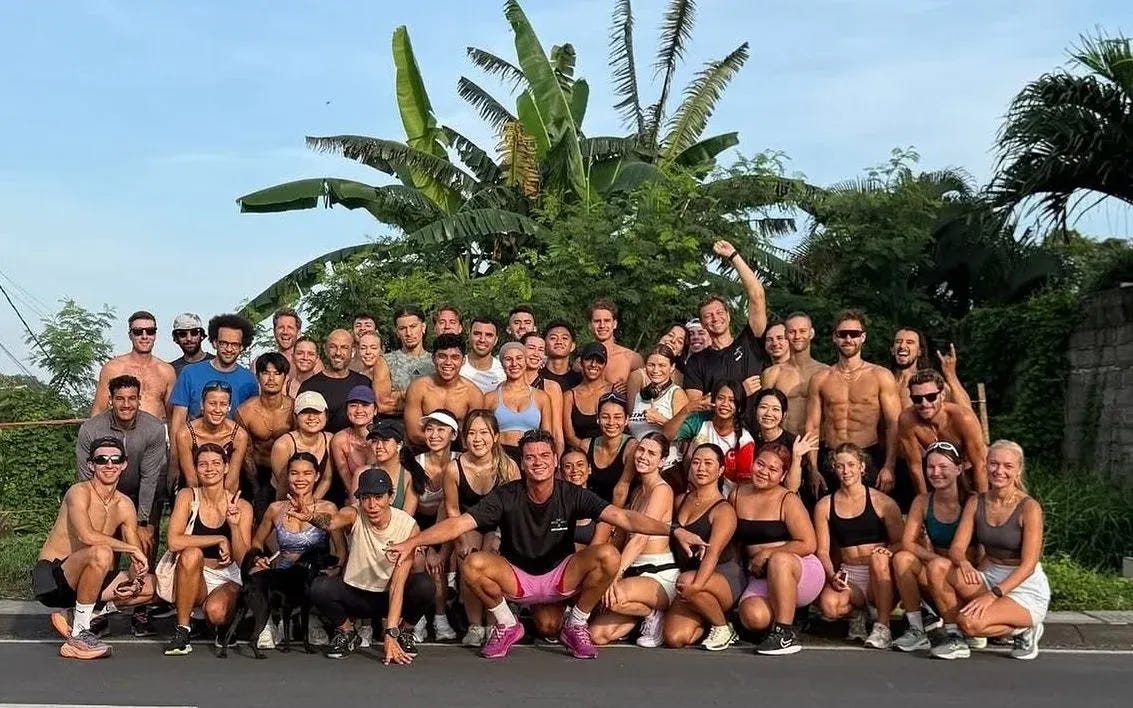
The reason a jogging club became a national story is that it fits a shape Indonesians already recognized. Since the pandemic, Bali’s foreign population has shifted from backpackers and retirees to a younger, laptop-carrying class living on business visas stretched to cover work they’re not technically allowed to do. They built a parallel economy — co-living spaces, content houses, members-only clubs — transacted mostly in dollars, requiring little of the language beyond ordering coffee. For this crowd, Bali became less a country than scenery.
Officials have started to push back. A new task force, Dharma Dewata, detained sixty-two foreigners in its first three weeks this spring, concentrating patrols in the same nomad enclaves — Canggu, Ubud, Seminyak — where Entourage recruited its members. The government now talks openly about “quality tourism,” which is bureaucratic shorthand for a blunter idea: fewer people treating the island as a stage set.
That framing — colonization dressed as convenience — extends well past running clubs. Balinese villages are still organized through the banjar, the customary council that has long overseen land and water rights, and the subak, the cooperative irrigation system that has shaped rice farming here for a thousand years. A national push to digitize land permits now lets investors apply remotely, cutting out the face-to-face consultation a banjar once required. Above the mountain village of Munduk, a water priest who tends a sacred spring as part of his family’s hereditary duties fields cold offers from developers for land his family has held for generations. The run club’s sign-up form and Bali’s land-permitting system are, in miniature and in aggregate, doing the same thing: sorting decisions away from the people who were here first, with just enough procedural cover to avoid calling it what it is.
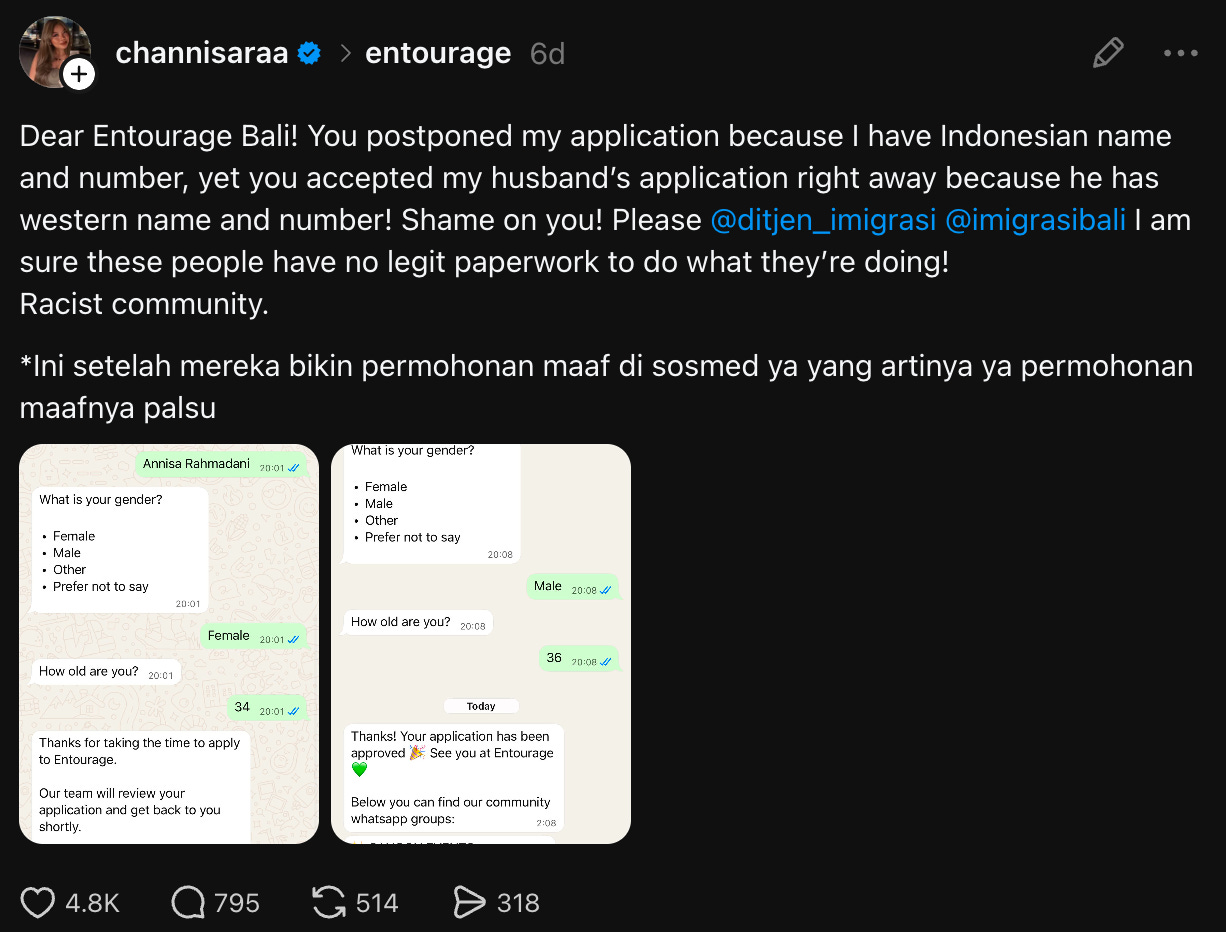


What makes the Entourage story travel is less the discrimination itself than the shrug underneath it — the sense that a place can be loved and appropriated in the same breath, sometimes by the same people, sometimes in the same sentence. Nobody set out to build an apartheid jogging club. But a community engineered entirely around the comfort of newcomers will eventually produce that outcome anyway, intentions notwithstanding. An automated filter on a WhatsApp form is a small thing. A permitting system that removes the banjar from the loop is the same instinct at scale.
None of this makes every digital nomad an accidental colonialist. Most pay fair wages, learn enough Indonesian to get by, and understand that being welcomed somewhere is a privilege, not a default setting. But Entourage is now the cautionary version of the story — proof of what happens when a “curated community” curates out the people whose country it’s in. Admitting Indonesians to a running club in Indonesia shouldn’t require a diversity policy. It’s the floor, not an achievement.
Storms and van Vliet are in Singapore. Entourage’s Sunday runs, if they resume, will presumably let anyone jog through the paddies before the mopeds start. The visa gray zones, the online permitting systems, or the customary councils losing their say over land their families have farmed for centuries. The run club was never really the story. It was just the first thing small enough — and human enough — for people to point at.
Below is a list of alternative running clubs presenting in the Bali region.
A curated community that curates out the people whose country it's in — wow. Glad they were booted.