


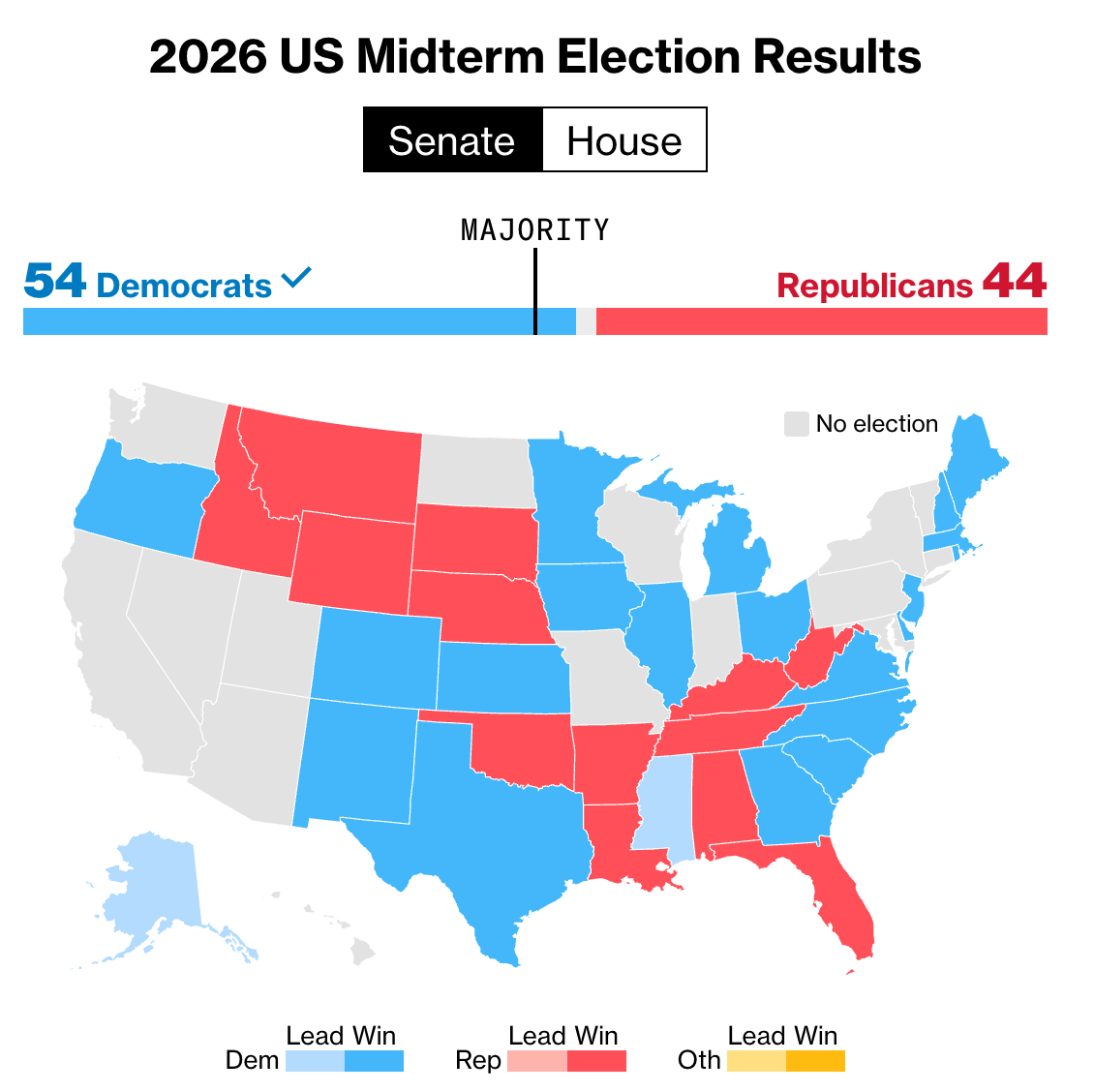
The English words “host” and “hostile” descend from the same ancient root, a word that meant, roughly, a stranger: someone with whom you had to decide, at the threshold, what kind of relationship to have. Every country makes that decision over and over, at airports and border crossings and the windows of consulates, and for two years the United States has seemed, to much of the world, to be leaning toward the second meaning. On Tuesday night, the voters chose the first. Democrats swept the House and the Senate in a night that kept getting bigger: seven Republican Senate seats flipped, House battlegrounds from Iowa to Pennsylvania to Texas turned, and Kansas sent a Democrat to the Senate for the first time in nearly a century. Abroad, the front pages went blue. Libération called it a vague bleue, and papers from Toronto to Mexico City read it as a setback for the President whose policies their readers had been avoiding with their feet.


It is tempting, on a morning like this, to read an election as a change of heart. In this case, I think the temptation is correct. The travel industry has spent two years watching the world decline America’s invitations, and on Tuesday the electorate did something no marketing campaign could: it told the world, in the most legible language a democracy has, that the welcome mat was never meant to be rolled up.
The ledger is worth recalling, if only because ledgers are where moods become visible. International arrivals fell from 72.3 million in 2024 to 68.3 million in 2025. This year was meant to be the correction, a season of invitations: the World Cup, the nation’s two-hundred-and-fiftieth birthday, the centennial of Route 66. The tournament filled stadiums for a few weeks in June, and then the slide resumed; overseas arrivals through September ran 5.7 percent behind last year. The Canadians, who used to come down the way one drops in on a neighbor, made about thirty percent fewer return trips this April than they had two Aprils before.
One can itemize the reasons: a $250 “visa integrity fee,” an ESTA charge nearly doubled to $40, a $100 surcharge at eleven of the great national parks, a proposal, since softened, to inspect five years of a visitor’s social media, an eighty-percent cut to Brand USA, the agency whose job is to tell the world to come. But itemizing misses the point a little. People do not cancel a honeymoon over forty dollars. They cancel it when the forty dollars seems to mean something, when a fee reads like a message. And what travelers abroad keep telling pollsters is that the message they heard was political. Which is precisely why an election might matter.
A new Congress cannot undo all of that by itself. Most of the frictions were made by the executive branch: the park surcharge by the Interior Department, the social-media rule by Customs and Border Protection, the tariffs and the talk of a fifty-first state by the White House. But for the first time in this Presidency, those choices will be made under the gaze of a co-equal branch with committee gavels, subpoena power, and a fresh mandate. Officials who once announced surcharges by press release will now be asked to explain them in hearing rooms.

What Congress holds is the purse, and the purse turns out to be where a welcome is quietly written. The visa fee and the Brand USA cut live in last year’s budget law, and changing them needs a President’s signature. That might sound like the end of the matter, except that tourism is one of the rare subjects on which Washington still speaks a single language. A bill to restore Brand USA’s hundred million dollars already has nine Democratic and five Republican co-sponsors, and the White House asked for the full amount in its own budget. There is a pleasing irony in the thought that divided government’s first act of hospitality might be an appropriations line about hotel occupancy in Orlando.
Gridlock is the standard forecast for divided government, but this is not the usual split. Democrats arrive in January with a large freshman class, many of whom won in places that live on visitors: districts with a national park, a convention center, or a border crossing that has gone strangely quiet. Representatives learn quickly what their districts sell. A good number of these new ones sell the experience of being somewhere else, and they know exactly what the last two years have cost.
Still, the deeper effect of Tuesday may have little to do with legislation. Travel supported some fifteen million American jobs last year, and nearly all of it rests on a private, almost sentimental calculation: a schoolteacher in Osaka or a retired couple in Winnipeg deciding whether the place on the postcard still wants them. They will not read the Congressional Record. What they saw on Wednesday was a country that argued with itself at full volume, voted, and accepted the result. The outcome, and the decisiveness with which the country delivered it, advertises the thing visitors have always come for: a place that is open, noisy, unfinished, and capable of changing its mind.
The kiosks at Kennedy will not change this week, and the fees will not vanish by spring. The stranger at the threshold is still a stranger. But the old root cuts both ways, and the choice between host and hostile is made not once but continually, in policy and in mood. On Tuesday night, the country chose the first meaning, loudly and unmistakably. The industry’s bet, and it is a good one, is that the world heard it, and that a great many people will now come to see for themselves.